My Solo Cabin Trip: Fire, Fear, and Lake Superior
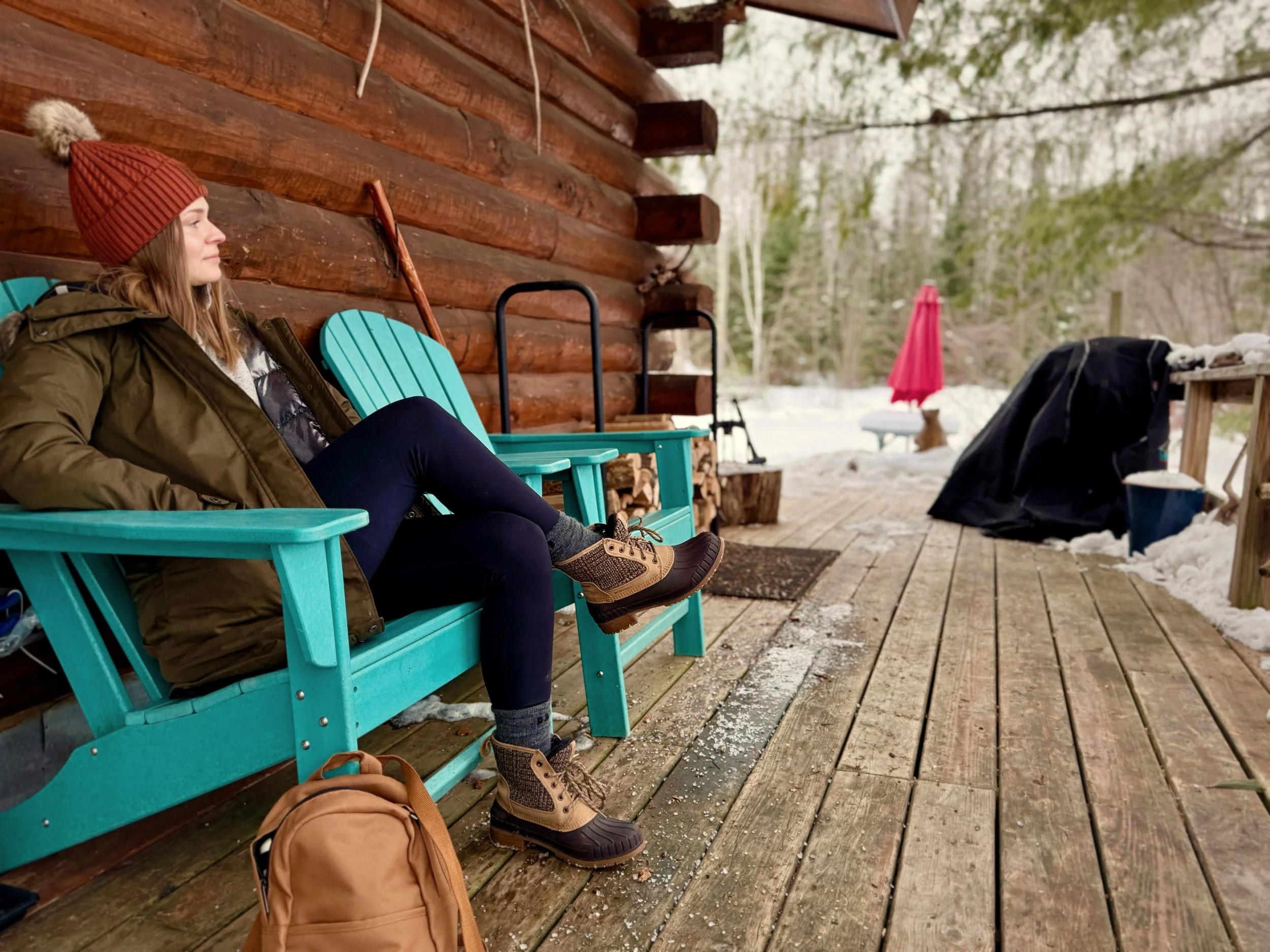
“I’m going on a solo trip… staying in a cabin in the woods of Wisconsin,” I said to the two friends sitting across from me over pizza and seasonal cocktails.
They looked back at me with blank stares.
“It’s totally safe,” I added quickly, rushing to soothe worries they may or may not have had. It was hard to tell in the silence. “I’ve wanted to do a solo cabin trip for a while. Just some time in nature. In solitude. I can work on writing.”
I realized I was working overtime to justify my decision to go alone.
“Okay…” one of them said finally. “I’m sure that’ll be really nice.”
I let the silence hang for a moment longer before changing the subject.
When I told another friend, he said, “Just be careful.”
He explained that sometimes men will specifically watch for solo women hikers. I nodded, thanked him, and quietly decided I wouldn’t be hiking any trails alone.
It wasn’t that I hadn’t thought about the risks. I had.
For a long time, I believed I couldn’t travel unless I was partnered. It didn’t feel safe—and I was convinced I wouldn’t enjoy it as much without someone there to share the experience with. And while some of that concern is valid—safety does matter—part of it was a mindset that held me back. Protected, but stagnant.
But now, in some strange way, the fear—still fully present—didn’t dull my excitement. It sharpened it.
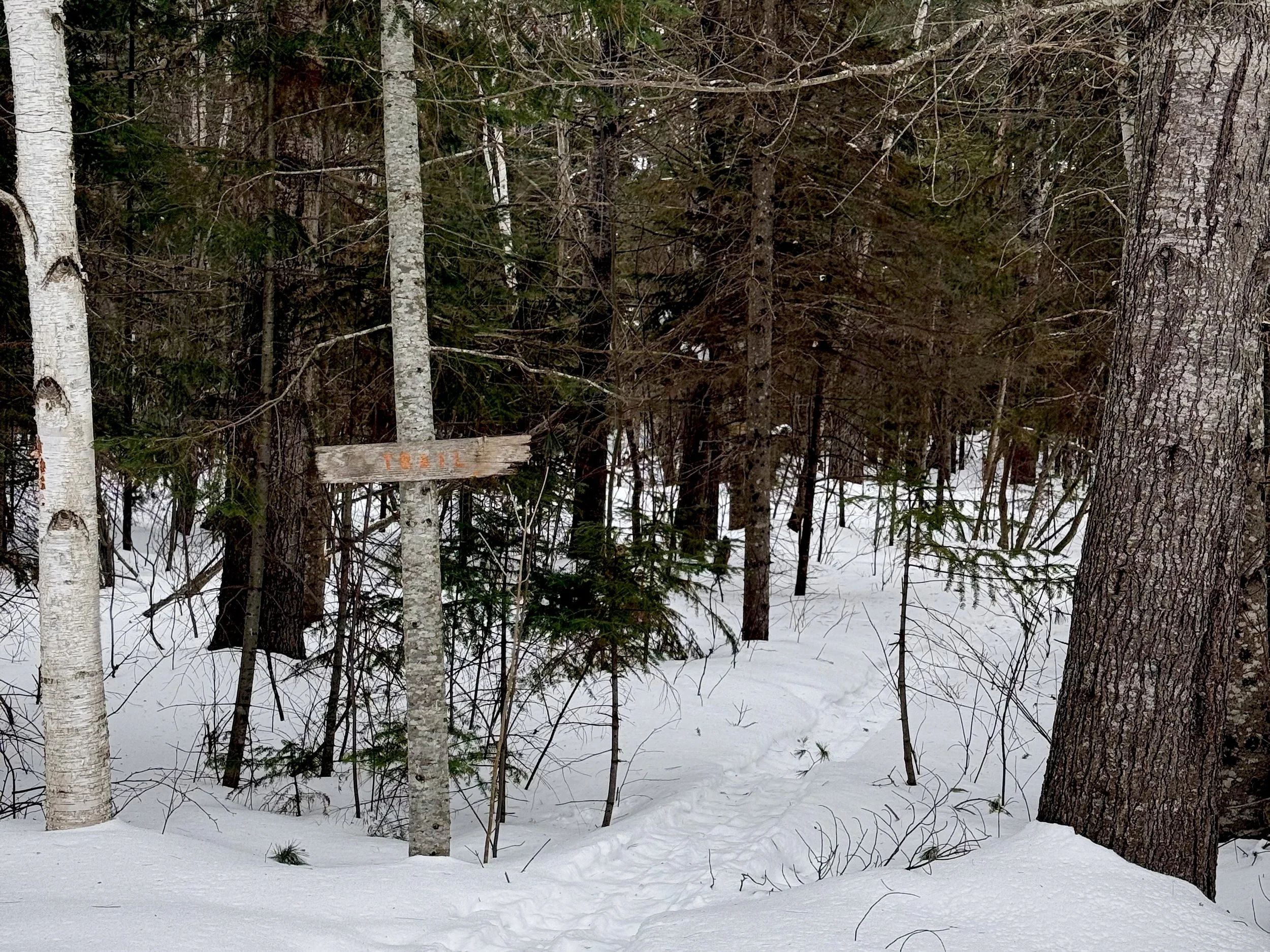
The rolling hills and forest-cradled highways filled me with happiness—and told me I was no longer in North Dakota. I completed the six-hour drive without a hitch, stopping only once in Grand Rapids for gas and a quick break.
Kristin, the Airbnb host, was waiting at the cabin to show me around and explain how to use the wood-burning stove. I’d noticed it in the listing photos—how cozy it looked—and had already made a mental note: There is no way I’m operating that thing. I had no experience with real, wood-burning fireplaces, and I wasn’t particularly interested in burning the whole place down with me inside it.
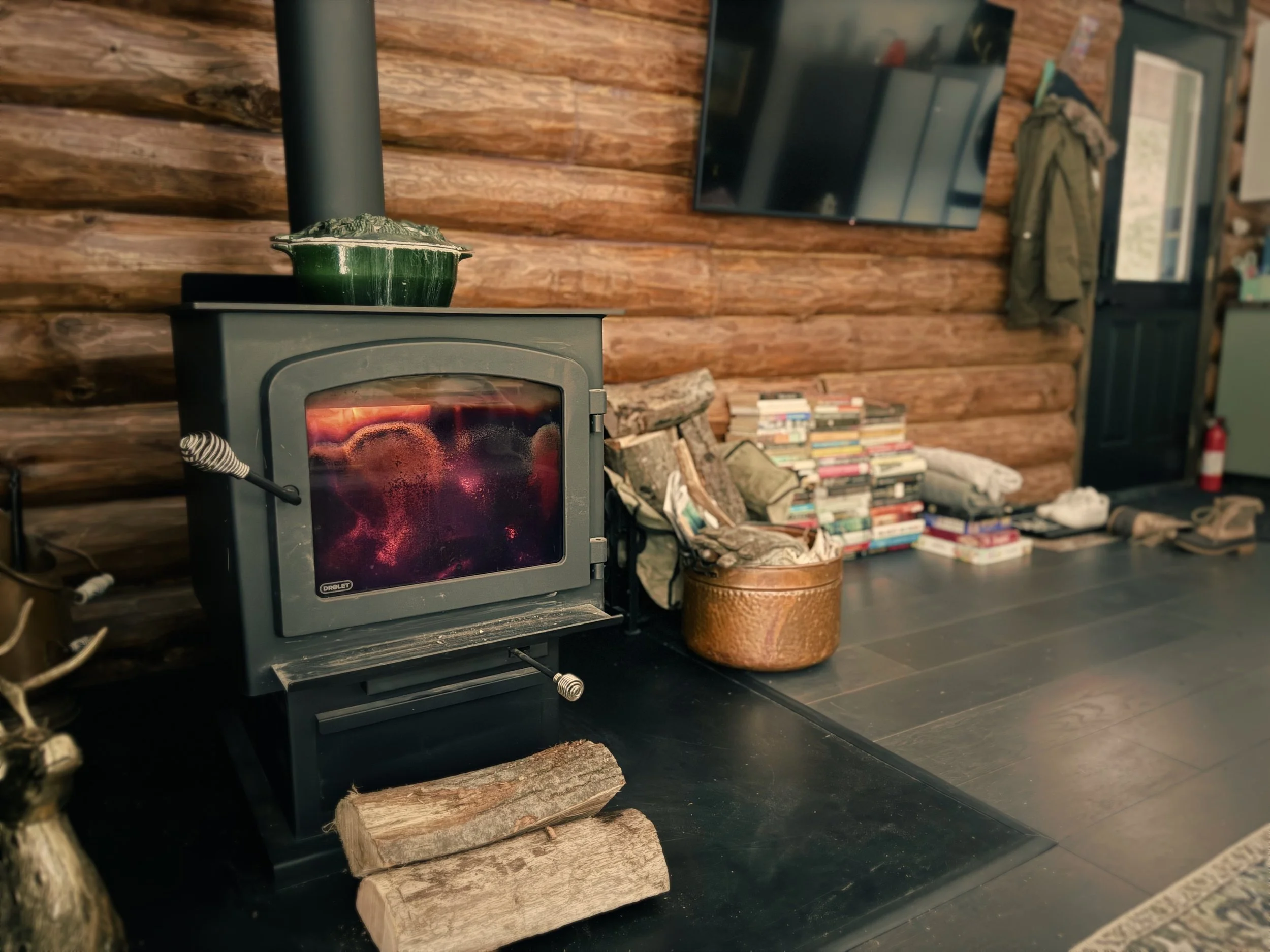
“You have to keep the fire going at all times,” Kristin told me. “Otherwise, you’ll freeze. And the pipes will, too.”
“Ohhh,” I said. “But this isn’t the only source of heat, right?”
She laughed. Yes, it was.
“It’s easy,” she assured me. “You’ll learn.”
Kristin was bright and cheerful—a beautiful middle-aged woman with long, dark hair tucked beneath a tightly knit, colorfully striped beanie. She looked tough, in her chunky black Carhartt jacket and worn-in jeans. She told me she rode a Harley and that she had six kids. Her skin still youthful, her eyes lively.
“If you need anything, just give me a call or text. I’m staying in Bayfield—about twenty minutes away,” she said before heading out.
I thanked her. She pulled away in her silver pickup truck. I was alone.
I started settling in, unpacking my bags and organizing my things. Even though it was late afternoon, I made myself a cup of coffee. I had a 7 p.m. dinner reservation at the St. James Social Restaurant in town and needed a little pick-me-up after a long travel day.
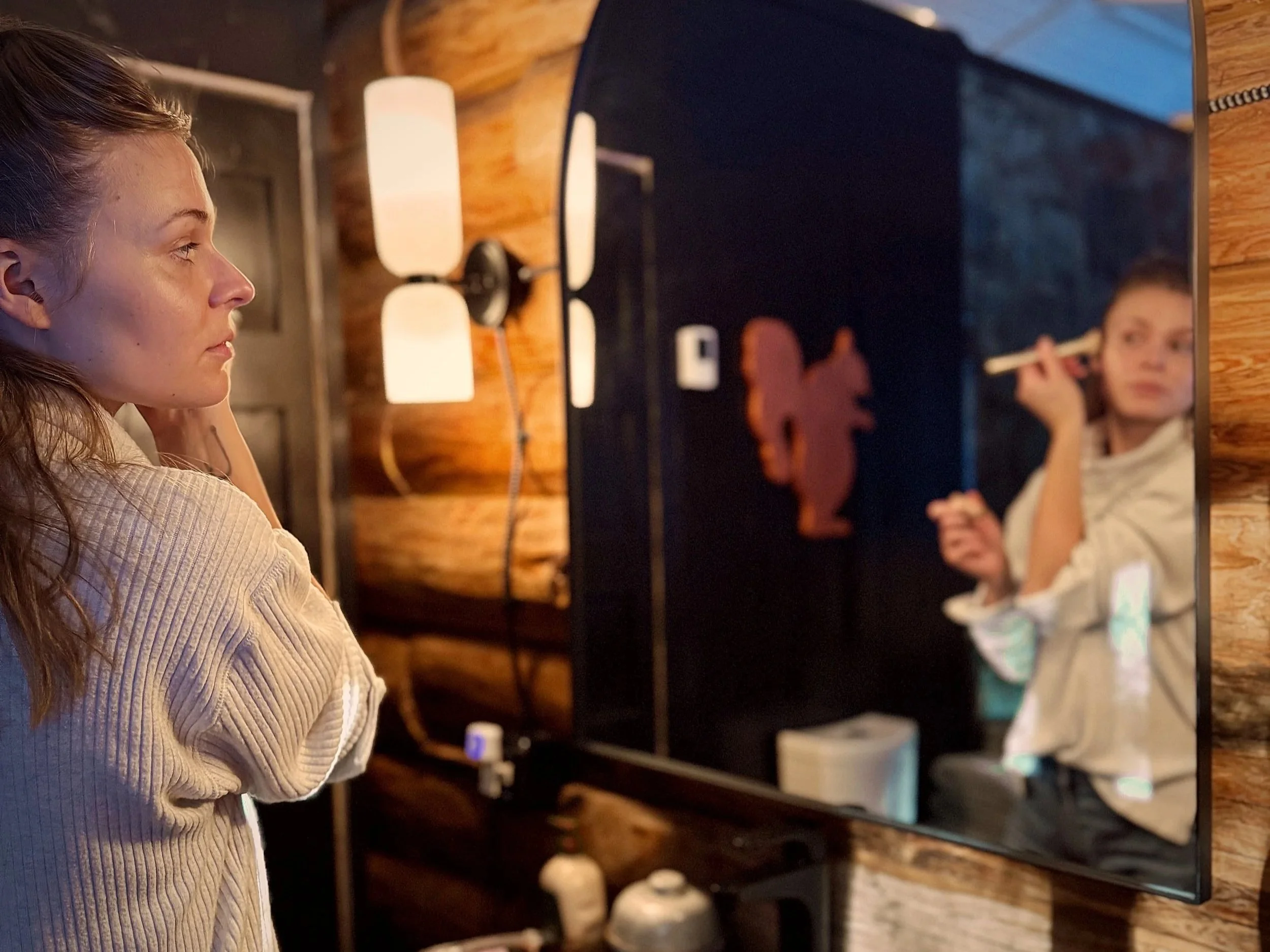
The teal-blue Keurig Kristin had found secondhand groaned as it reluctantly spit coffee into a cream-and-brown speckled mug from the cupboard above. Steam curled upward as I sipped and got ready, swapping my travel sweats for something dressier and taking my time with my hair and makeup. I wanted to go somewhere nice. I’d never taken myself to a restaurant like this before. It felt like a treat, just for me.
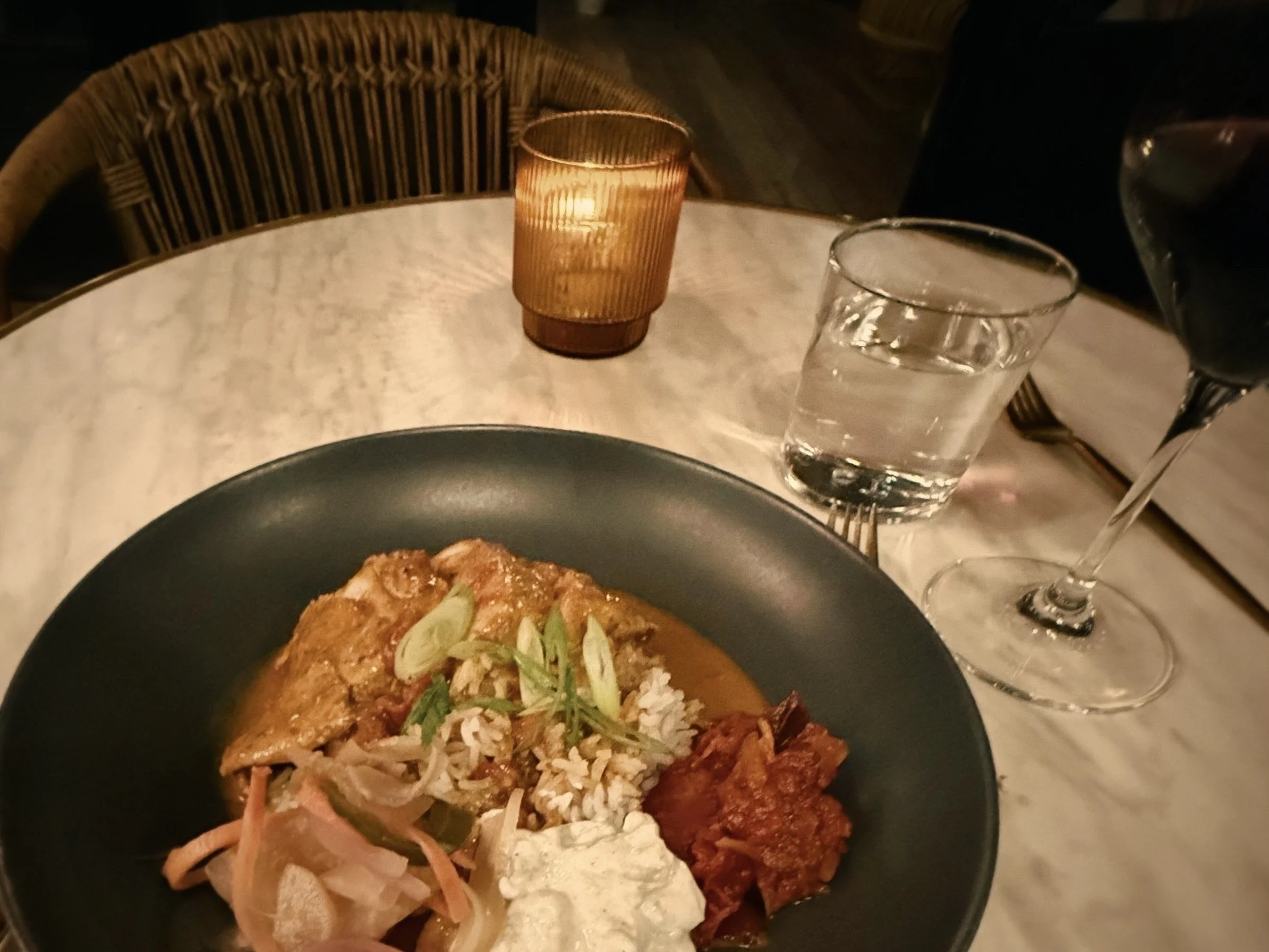
I arrived at the restaurant and was seated immediately by a young girl—elementary-aged, I guessed, probably the owner’s child. She led me to a small table tucked between two other small tables, set in front of a long, shared bench. Two couples sat on either side, likely enjoying a Friday night date. The space itself felt warm and lively, blending modern elegance with historic charm.
I tried to stay off my phone and just be present, but caffeine on an empty stomach and the winding drive in the dark left me jittery. I couldn’t stop scanning for ice, deer, other cars—a cautious alertness that lingered even as I settled into the restaurant’s safety. I shifted between checking my phone and taking bites of my butter chicken curry or slow sips of red wine.
A text from my friend Olivia lit up my screen, asking how the trip was going. Thank God. We messaged back and forth. I admitted I felt a little awkward sitting alone; she confessed she’d felt the same on a recent solo dinner. I felt seen. And a little less anxious.
I purchased a bottle of wine to go and made my way back, feeling a little more secure now that I had already traveled these roads once.
The night was crisp and clear. Stars winked overhead in the unpolluted sky, framed by tall pines that pierced the blue-black void. Somewhere, very near in the darkness, Lake Superior loomed like a ghost or an ill-kept secret. A massive, moving spirit made of equal parts ferocity and beauty. I would see her tomorrow on the guided ice cave tour I had booked weeks ago.
But first, I had to make it through my first night in the cabin.
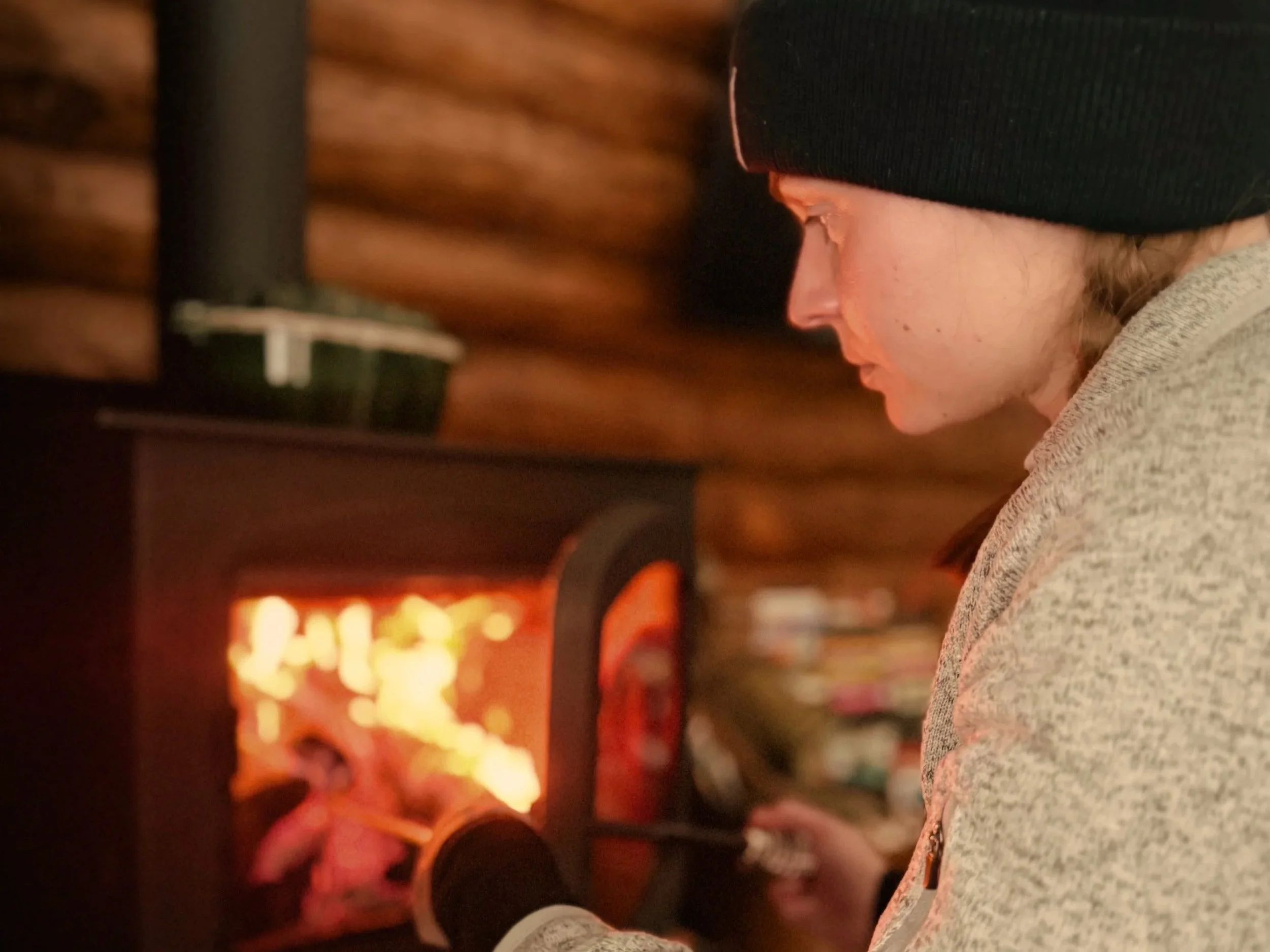
The log I’d tossed in before leaving had been burned down and hollowed out into a dusty carcass, brittle in its final moments before collapsing into the heap of coals and ash beneath it. I added a few pieces of kindling and waited for them to catch. Taking the poker, I putzed around, irritating the embers so that they hissed back at me. When small flames finally rose, I laid a larger log on top—only to watch it nearly suffocate them.
Ugh. So delicate.
More kindling. More poking, stirring, coaxing. Until finally, the log caught.
Therrrrre she is. A quiet flicker of triumph rising with the flames.
I changed into cozy sweats, washed my face, and pulled my hair into a messy bun. Then I poured myself a glass from the bottle of wine I’d picked at dinner, wrapped a thick gray blanket around my shoulders, and settled into the armchair facing the fire.
I was tired from the drive, but not worn down. The fire was mesmerizing, and I wanted to soak in the moment for all that it was. As I watched the bright orange glow flicker behind the soot-stained glass of the stove, I thought about the home I had driven six hours away from.
I wasn’t running from my life. I wasn’t trying to “get away,” the way people so often describe their reasons for traveling. It’s less of an escape and more of a supplement—an addition to an already content existence.
Travel is a welcome current that disrupts routine, keeping me sharp and full of wonder.
In many ways, that curiosity has been the rudder—subtly shifting and shaping the course of my life.
I stayed up until midnight reading, journaling, and finishing a glass of wine. Before bed, I added a few more logs to the fire, just as Kristin had instructed. Four should do it, I thought.
As I turned off the lights, I became suddenly aware of just how dark it was outside — and just how alone I was inside. The large picture window behind the bed and the sliding glass door revealed nothing but blackness. No window coverings. Just glass between me and whatever was out there.
I tried to ignore it, but the moment I slipped under the covers, every true crime documentary I’d ever watched came flooding back.
It’s always the nice blonde girls. The ones who light up every room. Dazzling. Charming.
I made a mental note to be less charming.
I’m near a tiny little town… those are generally safe.
Yeah. The sleepy little towns where nothing bad ever happens. Until one day….
Stahhhhp.
Kristin had told me she stayed out here alone often in the winter and hosted plenty of solo female travelers. She’d assured me it was safe.
Despite my nervous system’s best efforts, I eventually drifted off to sleep.
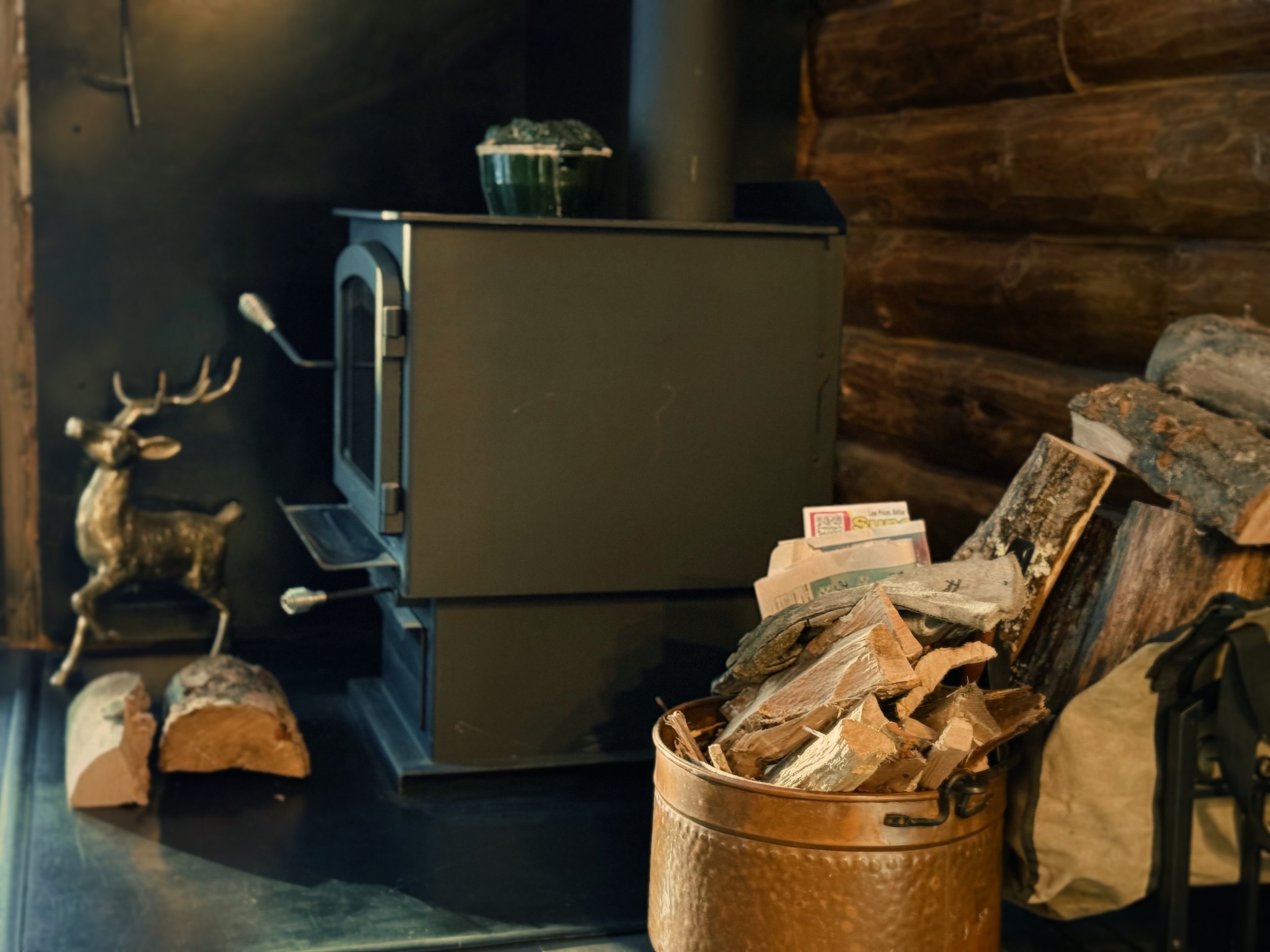
When I woke, it was still dark—quieter now, the loud whooshing flames I’d fallen asleep to reduced to almost nothing. The room whispered with soft crackles—like the last kernels at the bottom of a popcorn bag.
I slipped out of bed to check the fire. It had completely died.
It was only 2am.
Nooooo, I thought. The one thing I wasn’t supposed to let happen.
As I crouched in front of the stove, stabbing at the embers, prodding, praying, exhausted and cold, the words from a few of my married friends echoed in my head:
“I let my husband take care of that.” They said when telling me about their own wood-burning fireplace experiences—whether at home or on vacation.
In that moment, I wished that I could rest in the responsibility of someone else. But I couldn’t. If I wanted to keep both the cabin and myself from freezing… I needed to get this fire going.
I persisted—throwing in kindling, adding more logs, stoking it again and again until it finally roared back to life.
After waking up several more times throughout the night, the fire stopped feeling like a fire and started feeling like an infant—one I was responsible for keeping fed and content around the clock. My body became highly attuned to it: its sounds, its slightest drop in temperature, its unhappiness, its constant need for fuel. Even in sleep, I was listening.
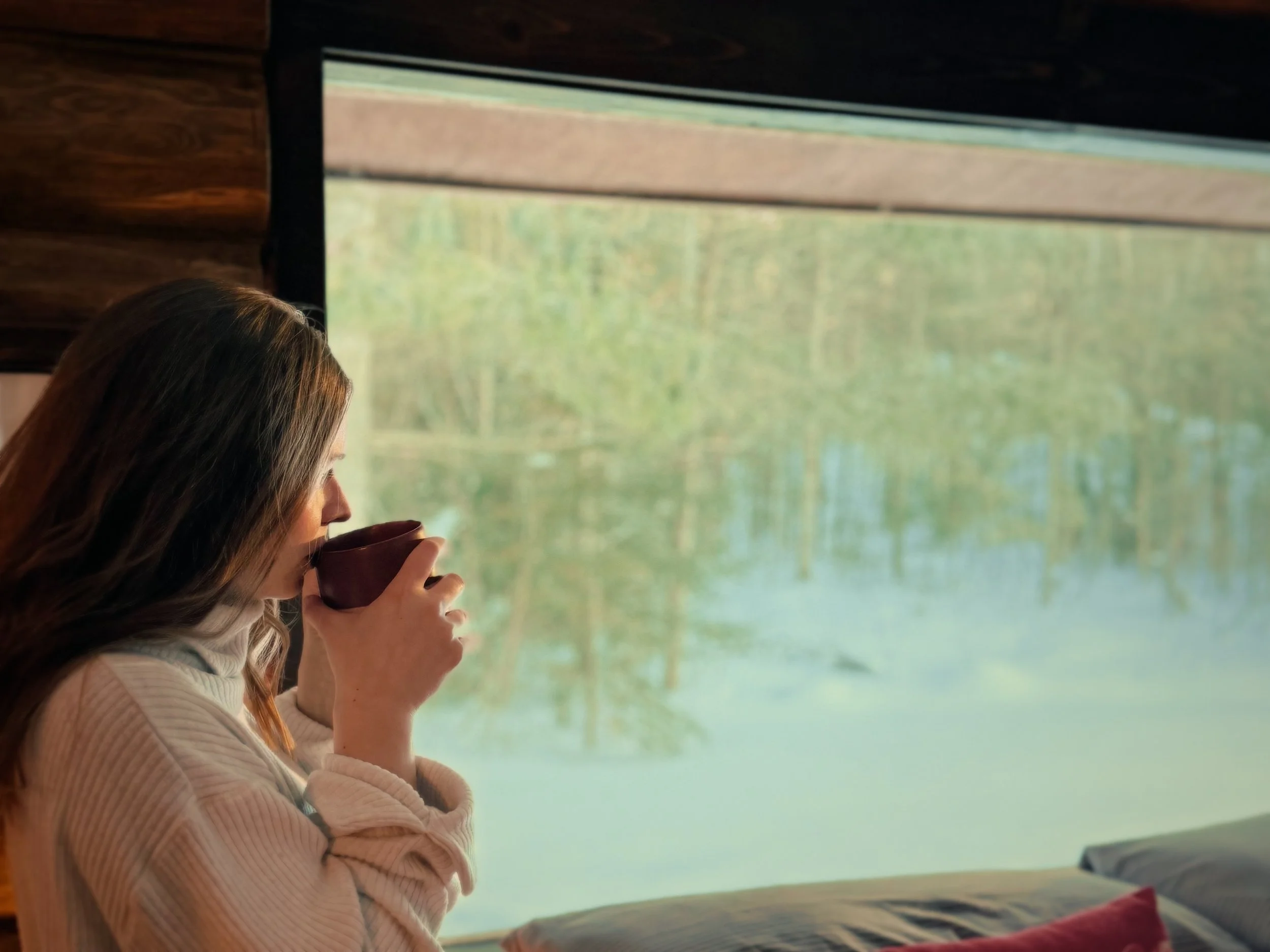
Morning arrived with soft, gentle light spilling through the wall of pine trees surrounding the little log cabin. I rolled over and checked my phone: 7:30 a.m. I had made it through the night. Barely. The last bundle of logs I’d shoved into the fire around 5 a.m. was still going strong—the flames laughing and dancing. Sure, nowww she’s happy.
I wanted to stay in bed a little longer, but I had to get moving if I wanted to make it to my guided ice cave tour.
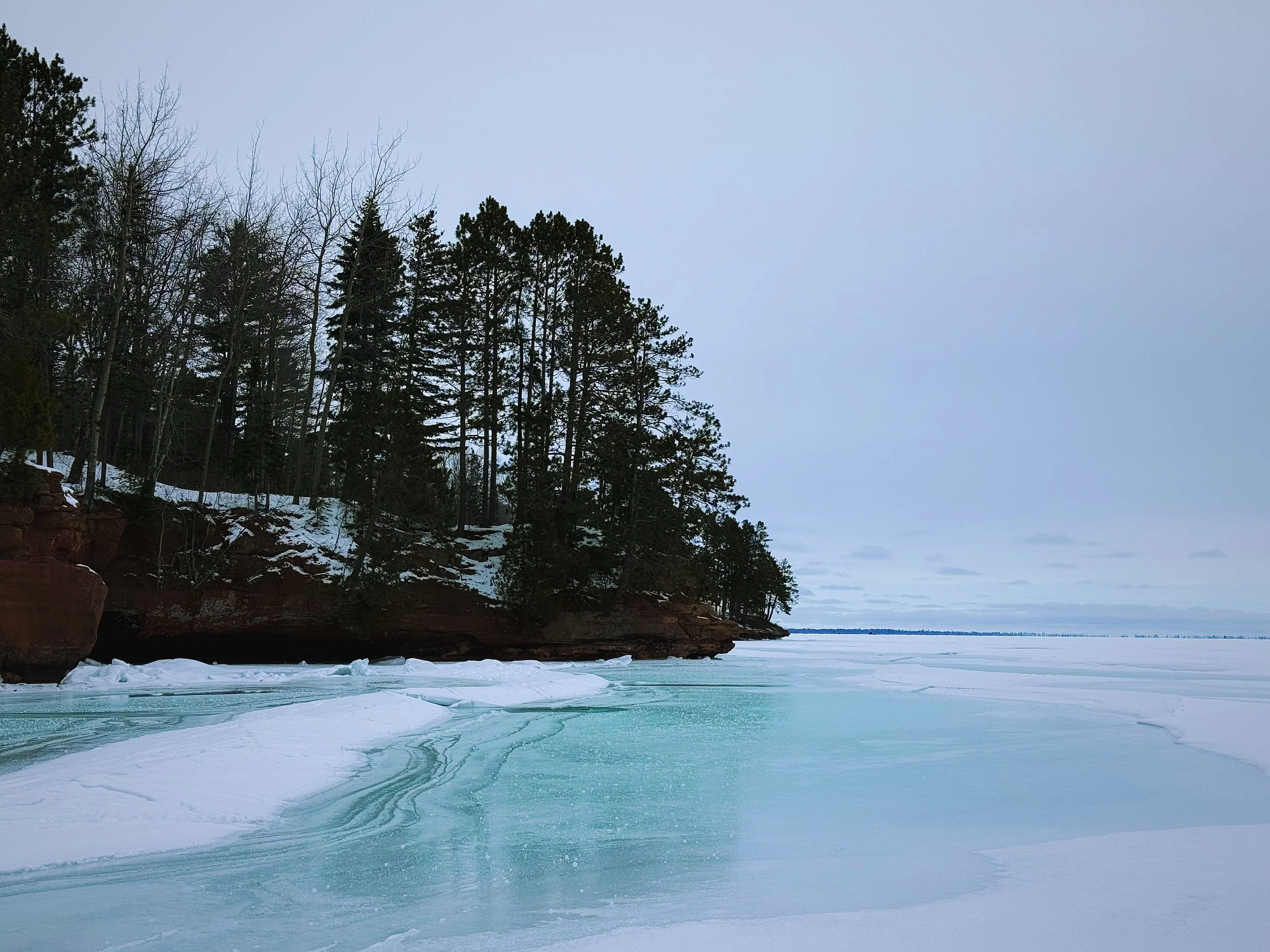
When I pulled up to the meeting spot at a little park campground near Chequamegon Bay, most of the group was already there.
I parked in line with the row of vehicles and walked over to the scattered cluster of people, crinkling and crunching in their winter gear.
The tour guide asked if I wanted snow cleats.
“Uhh… sure…” I responded, uncertain.
“What size?”
“Eight.”
“Okay, great—these will work,” he said, handing me a pair of rubber cleats that slid over my boots.
We began our descent down the hill toward the frozen water.
Lake Superior stretched out before us, magnificent. No longer a secret shrouded by the night, but a wide-open expanse of treachery and excitement—ready to be explored.
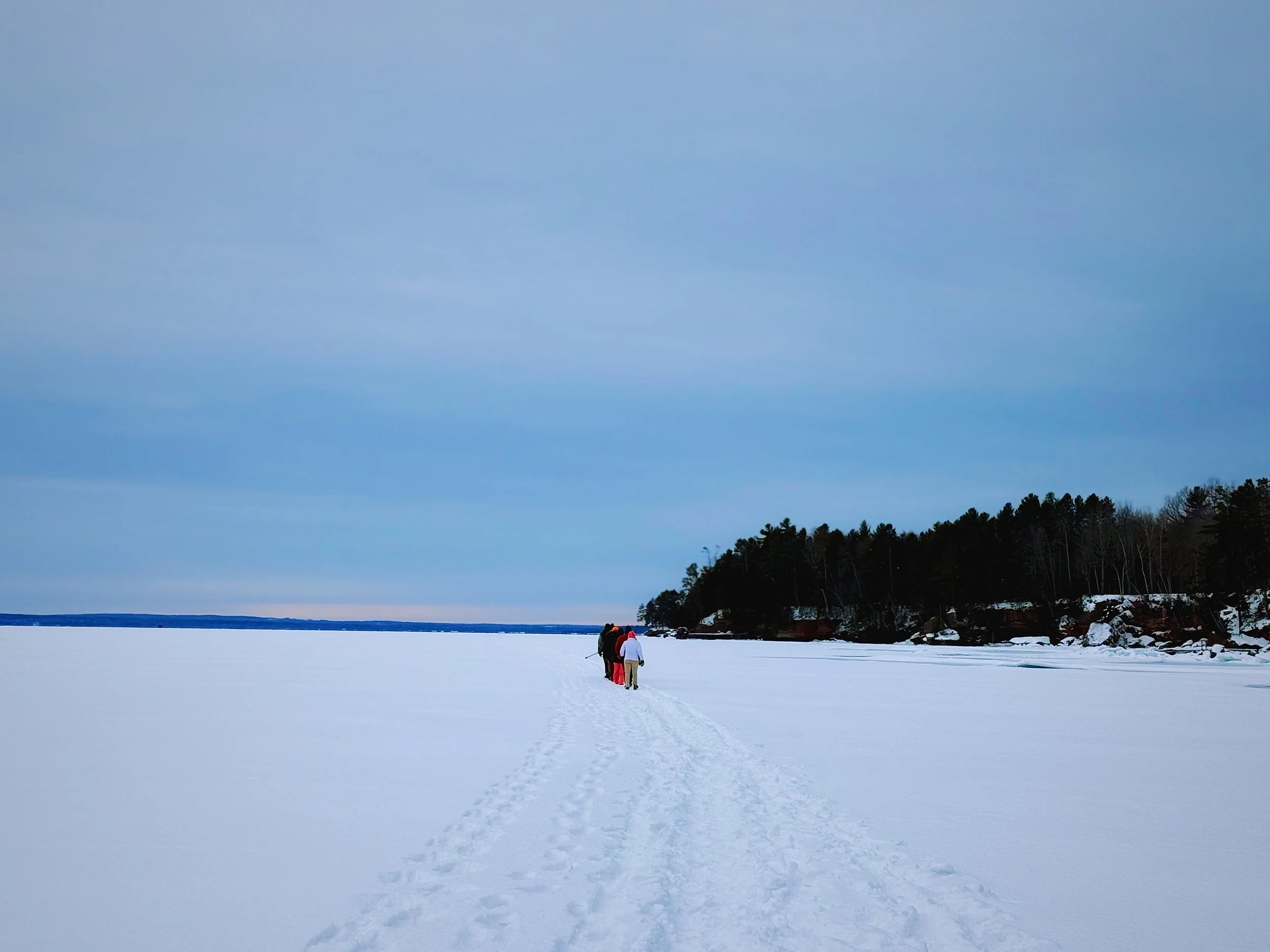
The Great Lake Itself—roughly 350 miles long and 160 miles wide—almost never freezes over completely. Its size, depth, and constant winds make full ice cover rare. But shallow bays and shoreline areas can freeze solid, which is what makes ice caves possible (and usually safe) in certain areas.
The twelve of us formed a loose circle around our tour guide once we reached the ice. As he began running through the safety guidelines and the day’s itinerary, a loud CRACK! bellowed and groaned beneath our feet. We all looked around nervously, silently checking to see if everyone else heard it too.
“It’s okay!” the guide assured us. “It’s just the sound of the waves crashing against the ice below. You’ll probably hear that all day long. Nothing to be worried about.”
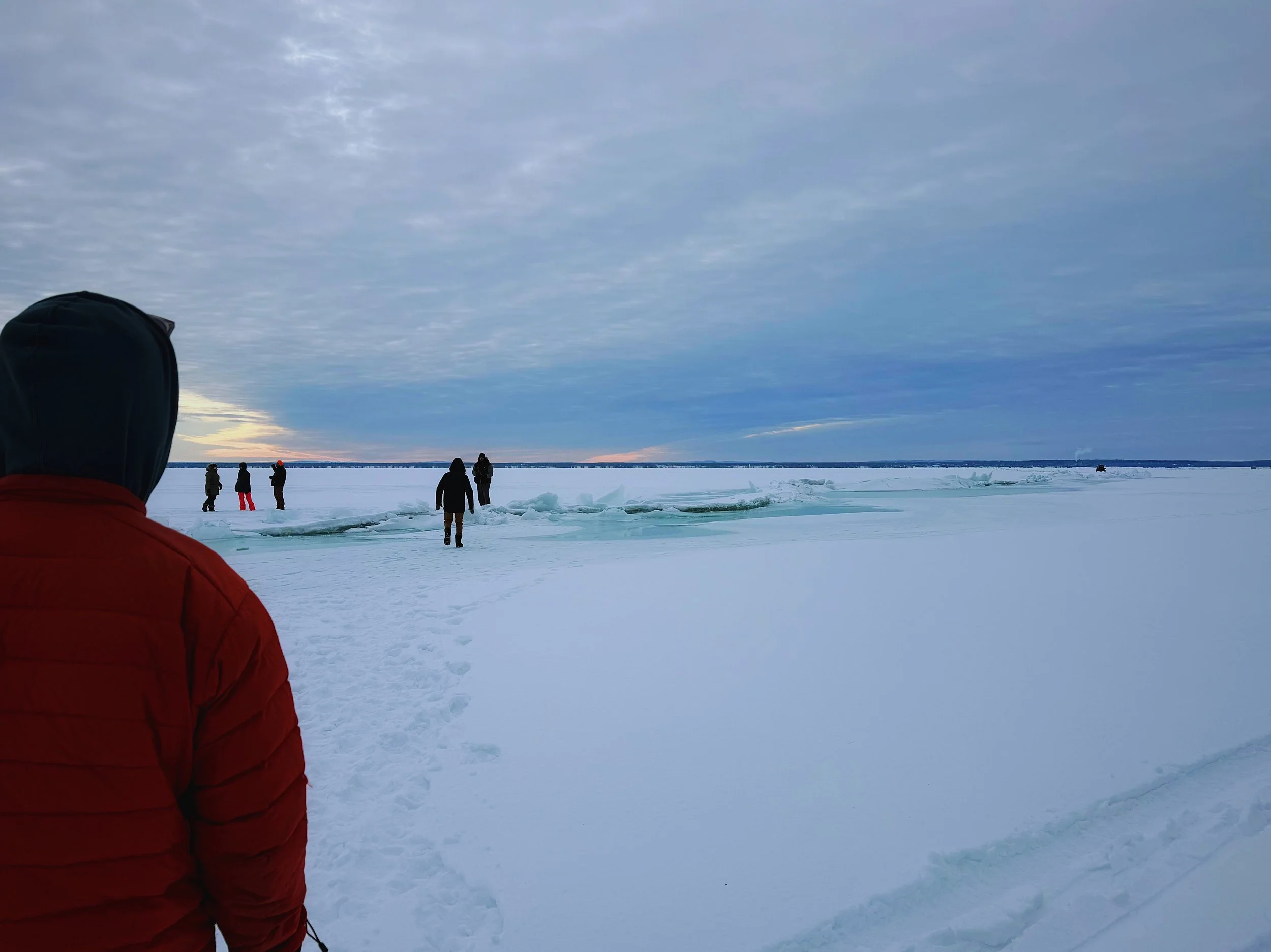
But I was worried. Though originally from Minnesota—the “Land of 10,000 Lakes”—I was raised in North Dakota, a virtually waterless state, so I didn’t have much experience with “ice behavior.” Ice behavior? Whatever you want to call it.
There was a large rift at the start of our trail—a “pressure ridge,” the guide explained—formed when sheets of ice push and buckle against each other. We’d have to carefully leapfrog across it. He tested each shifted plate with his ice pole before stepping forward himself.
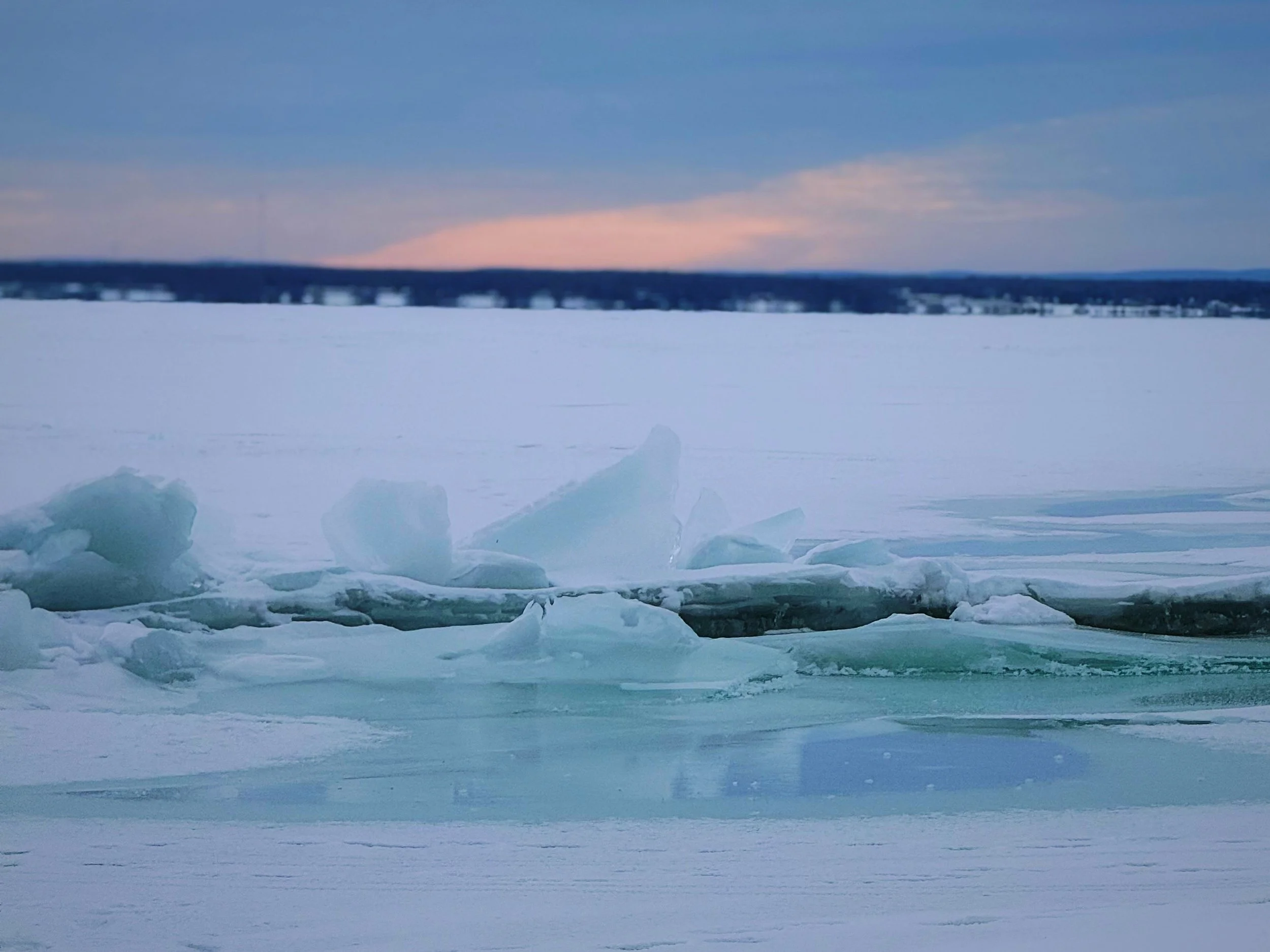
I was even more sketched out.
“Yeah, so basically just don’t step wrong, otherwise your foot could fall through,” he said, with barely any fervor—as if he were casually pointing out that the sky was blue.
He directed us to cross the ridge one at a time, so as not to add too much weight all at once.
I slunk to the middle of the forming line, figuring it’d be safer to let a few people go ahead and test it first. But I didn’t want to be last, either—not with the repeated pressure on the ice and the thought of it buckling beneath us.
This is not how you die, Ruth, I told myself, thinking about scenes from movies where someone suddenly drops through the ice after one quick fracture. I wondered if that’s really how it happens.
When it was my turn to cross, I approached cautiously, testing each piece of ice before stepping as quickly as I could. My boots landed on solid ground, and I joined the others who had gone before me.
Nailed it.
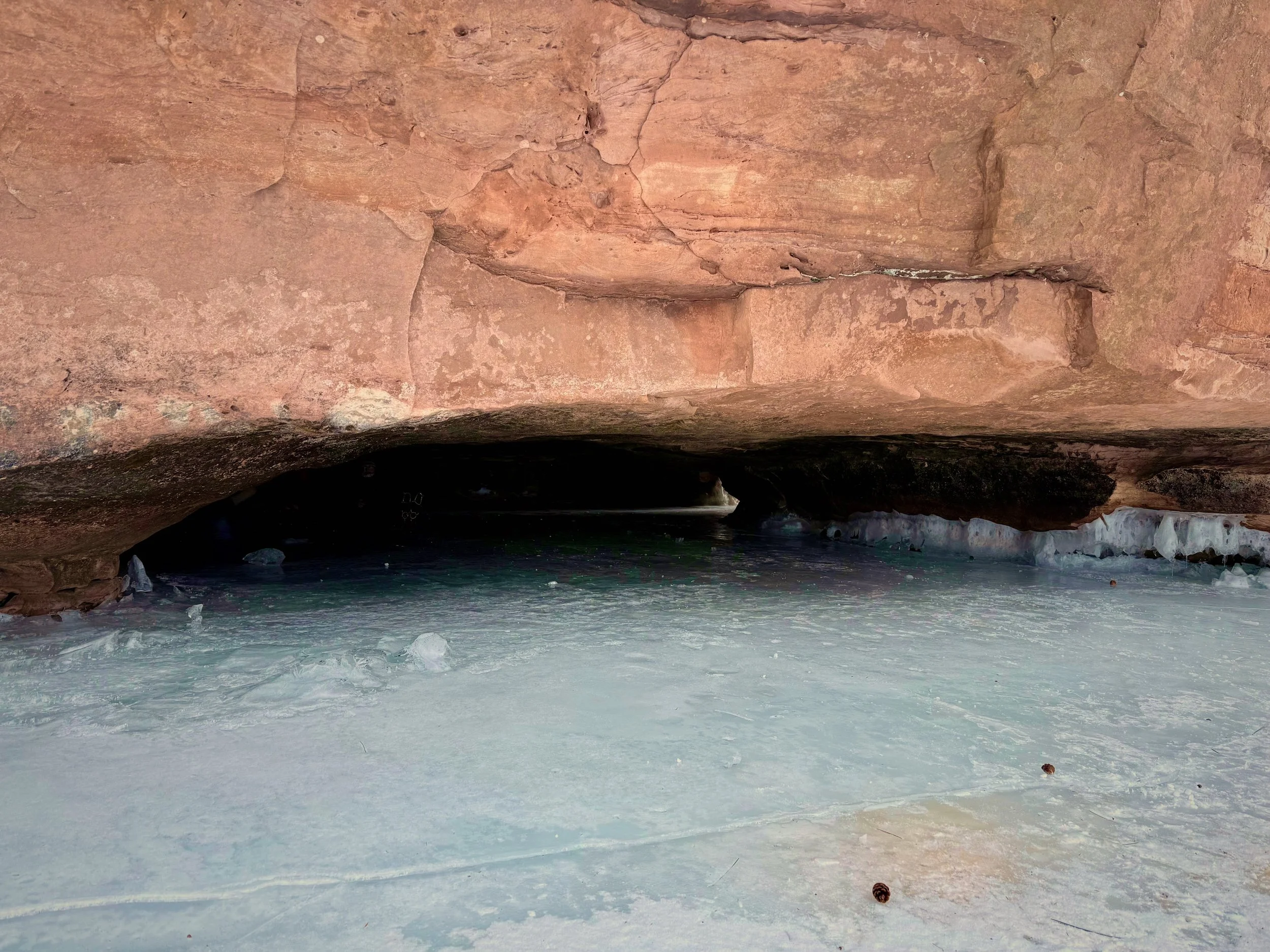
The ice caves were nothing like I expected.
The tour company’s website had shown dazzling frozen formations—sculptural, glittering, perfectly framed in sunset light. But what I quickly came to understand was that the “ice caves” weren’t really caves at all. For the most part, they were stretches of shoreline dotted with frozen waterfalls.
Oh. It’s a shoreline hike, I realized.
We had three main stops along our three-mile trek—one way. At one of them, there was a small cave, accessible only by scooting across the frozen floor, crouched down, so as to not hit our heads on the low ceiling.
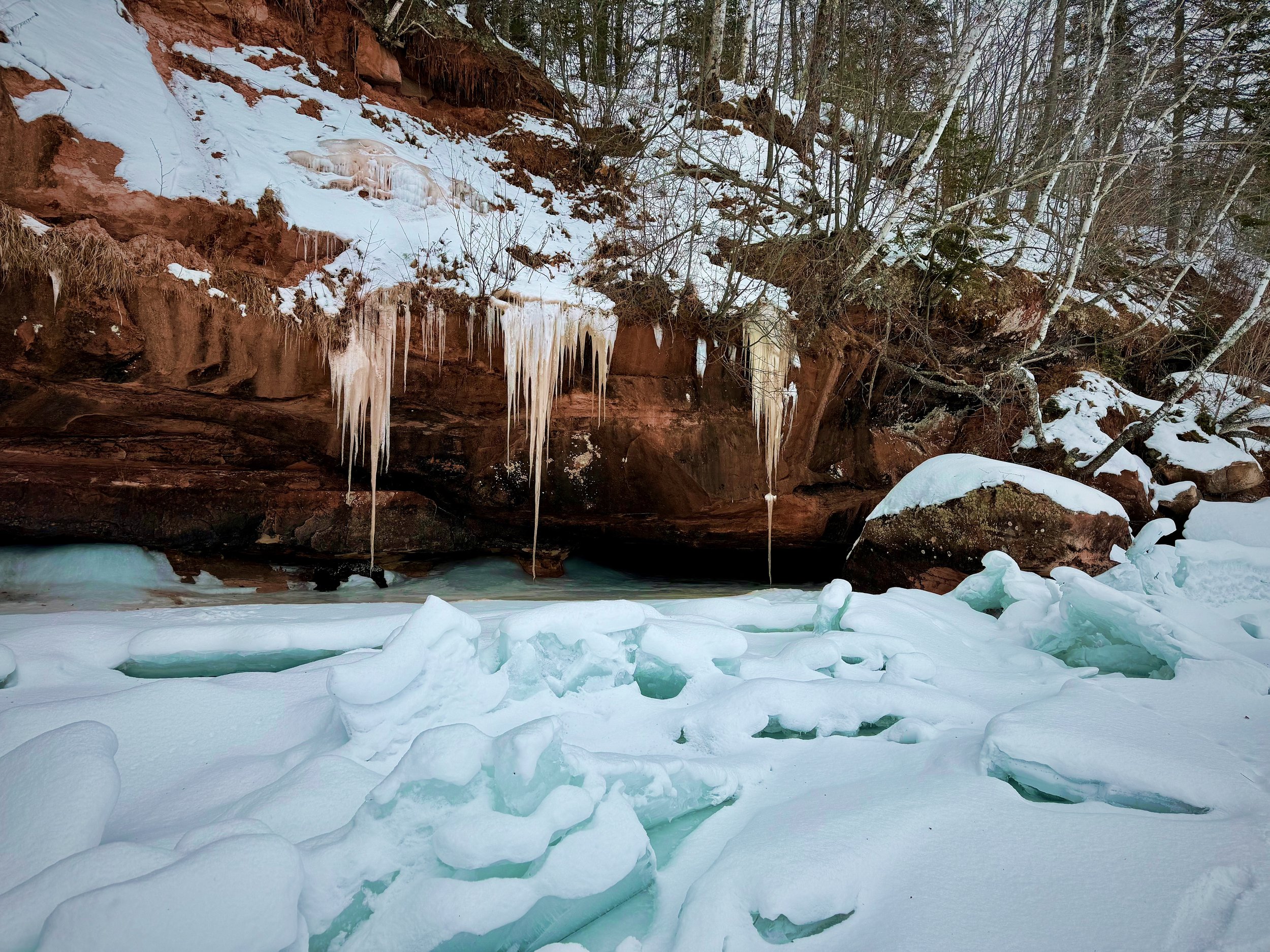
Another stop opened up to a wide stretch of quarried rock—the rusty brownstone swirling into powdery white snow like Cinnamon Toast Crunch. Gobs of smaller icicle formations hung like stretched-out gum stuck along the shoreline, frozen mid-drip.
Our third and final stop was the grand waterfall. We all oohed and aahed as we approached, pausing to take it in. People snapped photos and videos—friends posed for each other, boyfriends captured their girlfriends. I asked a friendly woman I’d exchanged pleasantries with along the trail if she wouldn’t mind taking my photo.
“Of course!”
I posed in front of the towering waterfall, and she asked if I’d do her the same courtesy.
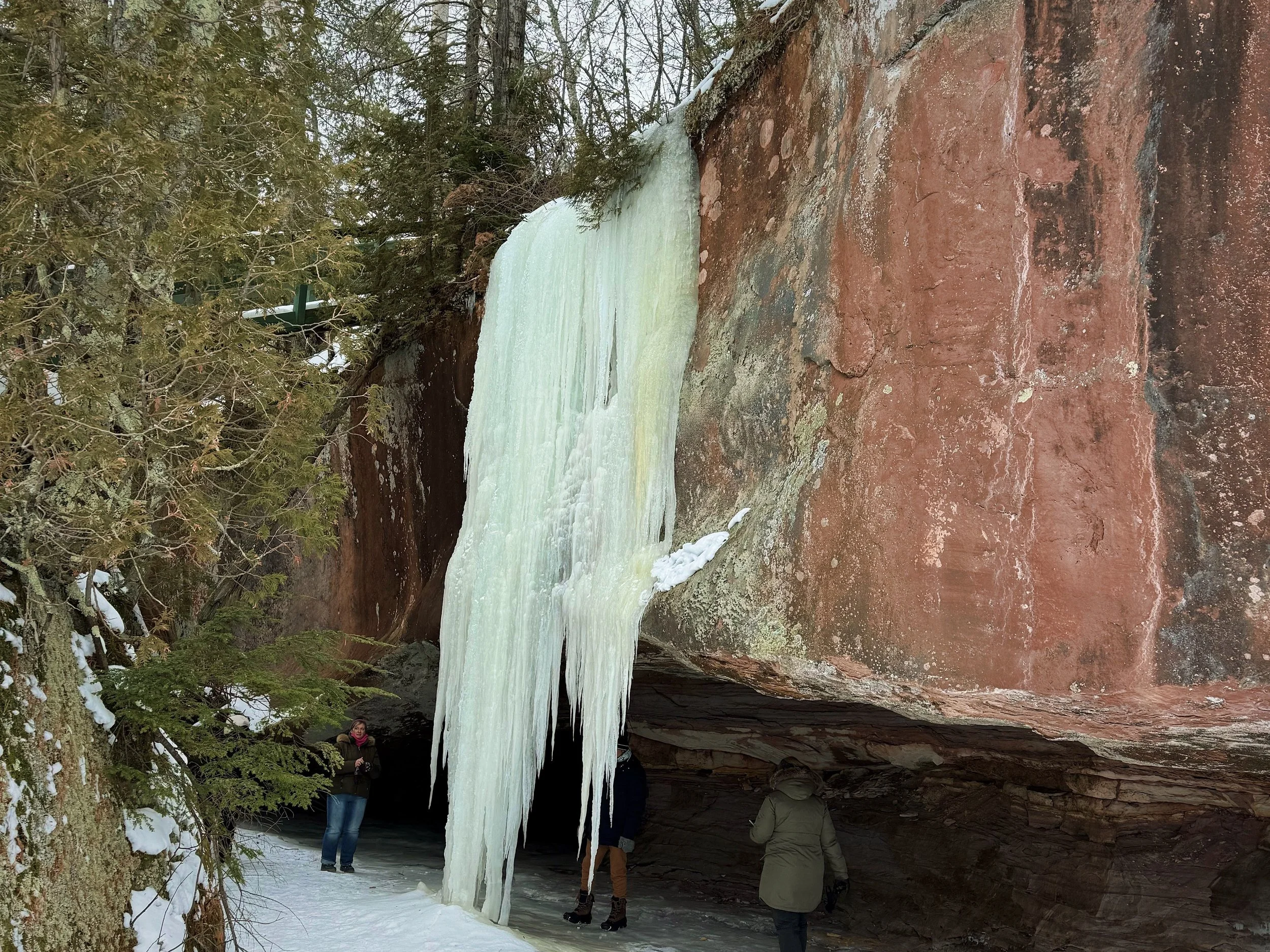
Despite the “ice cave tour” being more of a walk across Lake Superior, I thought it was a really great hike. Six miles total—weighted down by heavy boots and thick snow pants, trudging through snow and stepping tensely across brittle patches of ice.
By the time we turned back, a throbbing soreness had settled into my hips, the kind I knew I’d need to stretch out once I made it back to the cabin. Snowmobiles whirred across the lake in the distance, the horizon dotted with brightly colored ice fishing houses. We took small breaks along the way, waiting for others to catch up.
I took quiet pride in the fact that I was part of the quicker-paced group.
Those CRACKS!—from the waves rolling beneath the ice—followed us all the way back to shore, making my heart jump every single time. Each one sparked the same intrusive thought: maybe this will be the moment the ice splits open and swallows us whole.
But it didn’t. We made it back safely, relief washing over me the second my boots hit solid earth.
I’d managed to escape the clutches of Lake Superior this time.
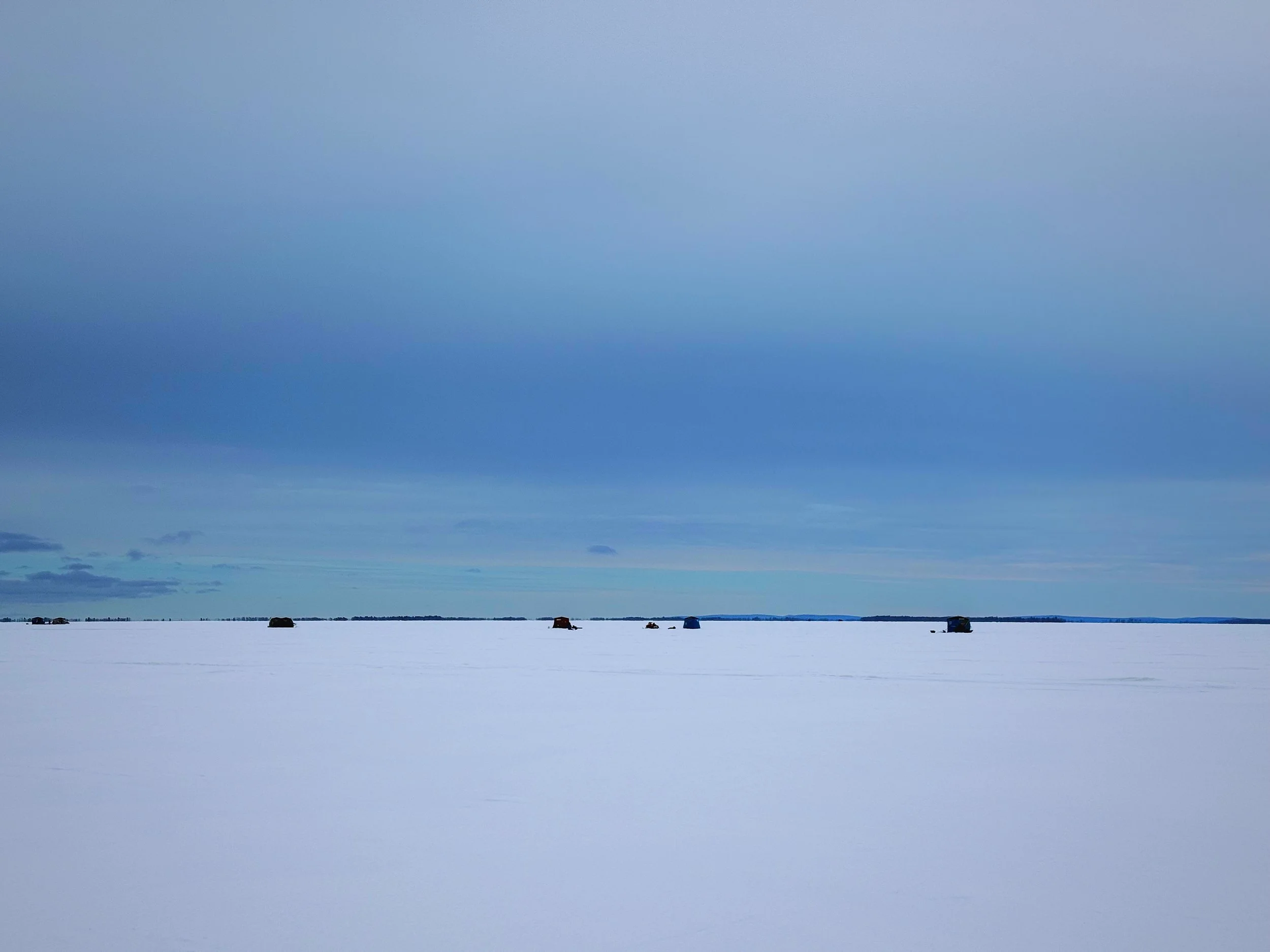
I warmed up with a lavender latte and chicken wrap at Mannypenny Bistro in Bayfield—a casual little spot overlooking the Great Lake I had just walked over. While I ate, sipped, and rested, I tried to stretch out my calves, which had seized into instant charlie horses the minute I yanked off my boots and snowpants after the hike. Sitting in the passenger seat with the door wide open, my muscles tensed as I leaned forward, fumbling to get my boots back on while my feet kept slipping in the snow. I cursed out loud in pain, fully aware—and not caring whatsoever—that a pair of hikers from the group still parked behind me was watching me struggle.
How fun for them, I thought.
After lunch, and before heading back to the cabin, I stopped at Captain’s Spirits to pick up a case of Spotted Cow for a friend who had requested it from back home. Produced by New Glarus Brewing Company, the popular farmhouse ale is only available in Wisconsin. I myself wanted to try it as well, so we’d be splitting it up between the two of us.
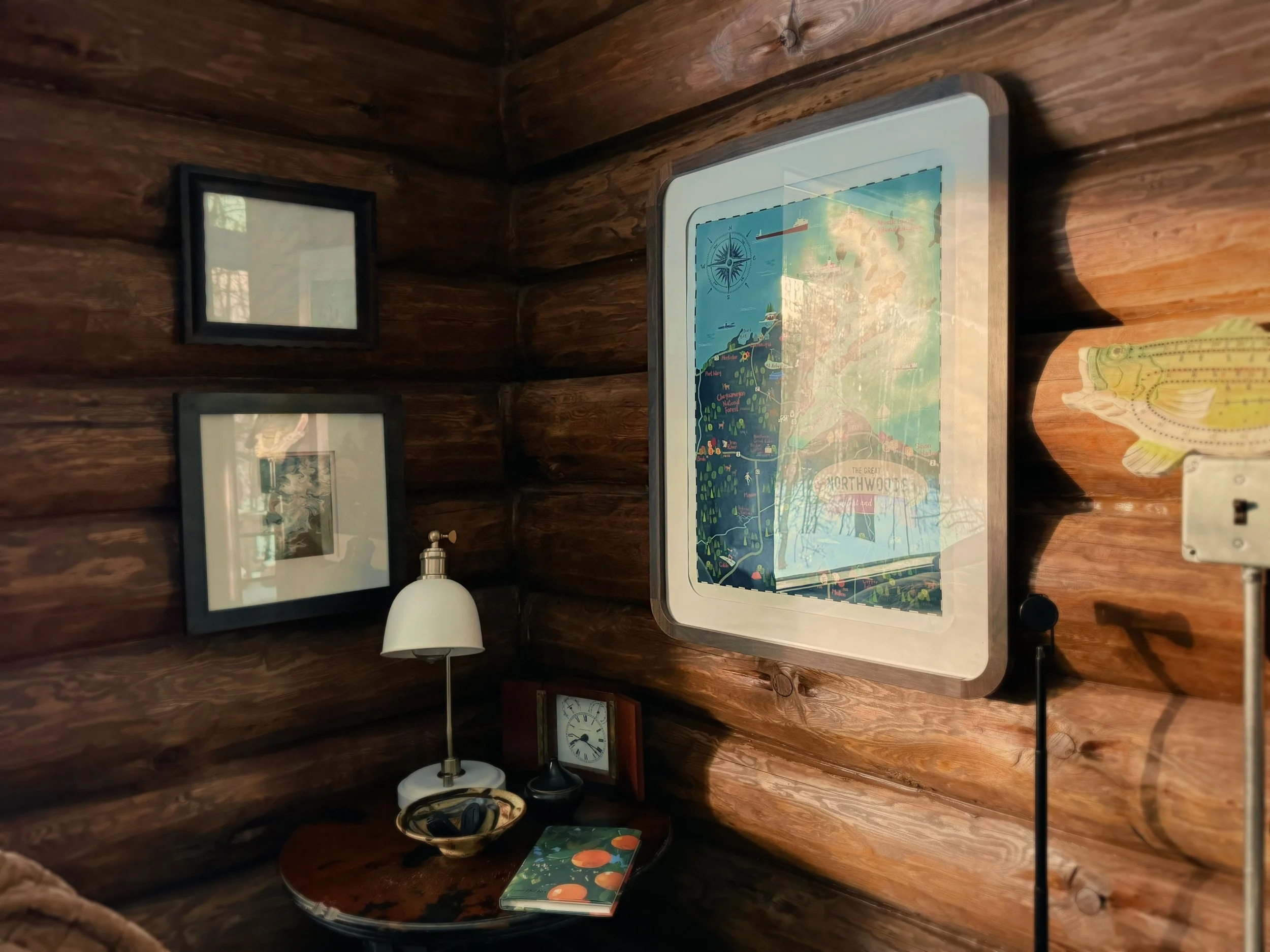
Not 30 minutes after I returned—seated in front of my frenemy, the fire—Kristin called to check on me. While I’d been out on the hike, she’d offered to stop by and keep the fire going, which I appreciated.
I usually freeze up at unexpected phone calls. It’s like my amygdala hasn’t yet evolved to detect the difference between being hunted by a bear and just hearing my phone ring. But this time it didn’t bother me. Kristin is chatty and friendly—most Airbnb hosts are more like ghosts, you never see or hear from them. She said she thought it was so cool that I was traveling solo, that she’s always curious about her solo female guests. She didn’t directly ask why I was there alone, but I could feel her genuine admiration.
There wasn’t really a deeper reason—I just wanted to do it. I wanted to push myself, explore, problem-solve, be self-content in my solitude.
It was interesting though, that everywhere I went, I was surrounded by pairs. I was happy for them—flirting at the restaurant table beside me, a partner checking on the other as we marched like ducklings across frozen Lake Superior. She kept glancing around whenever he slipped out of sight, as if tethered by some invisible string. Did he fall behind? Get lost? She probably worried about him the way I worried about my damn wood-burning stove.
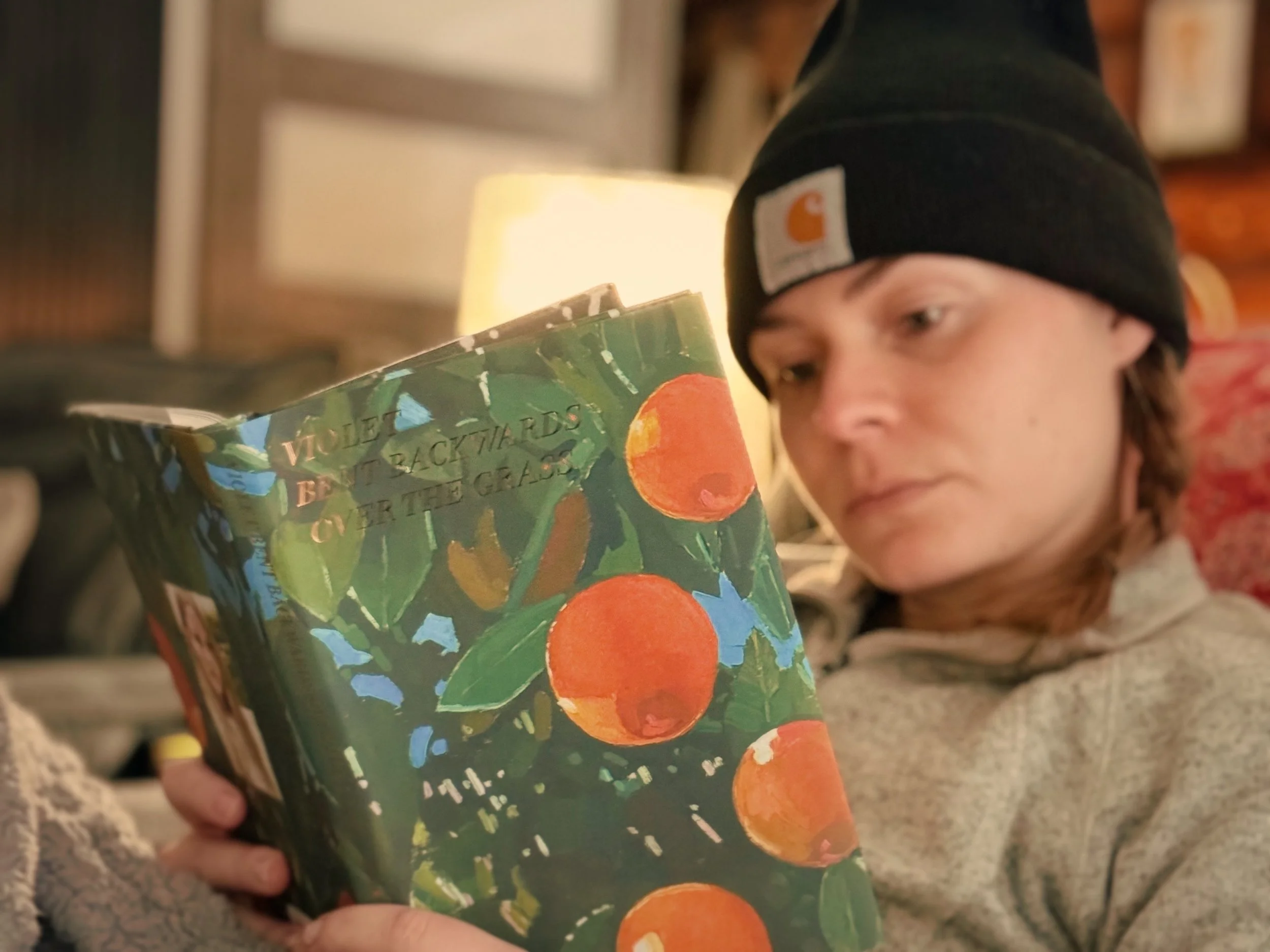
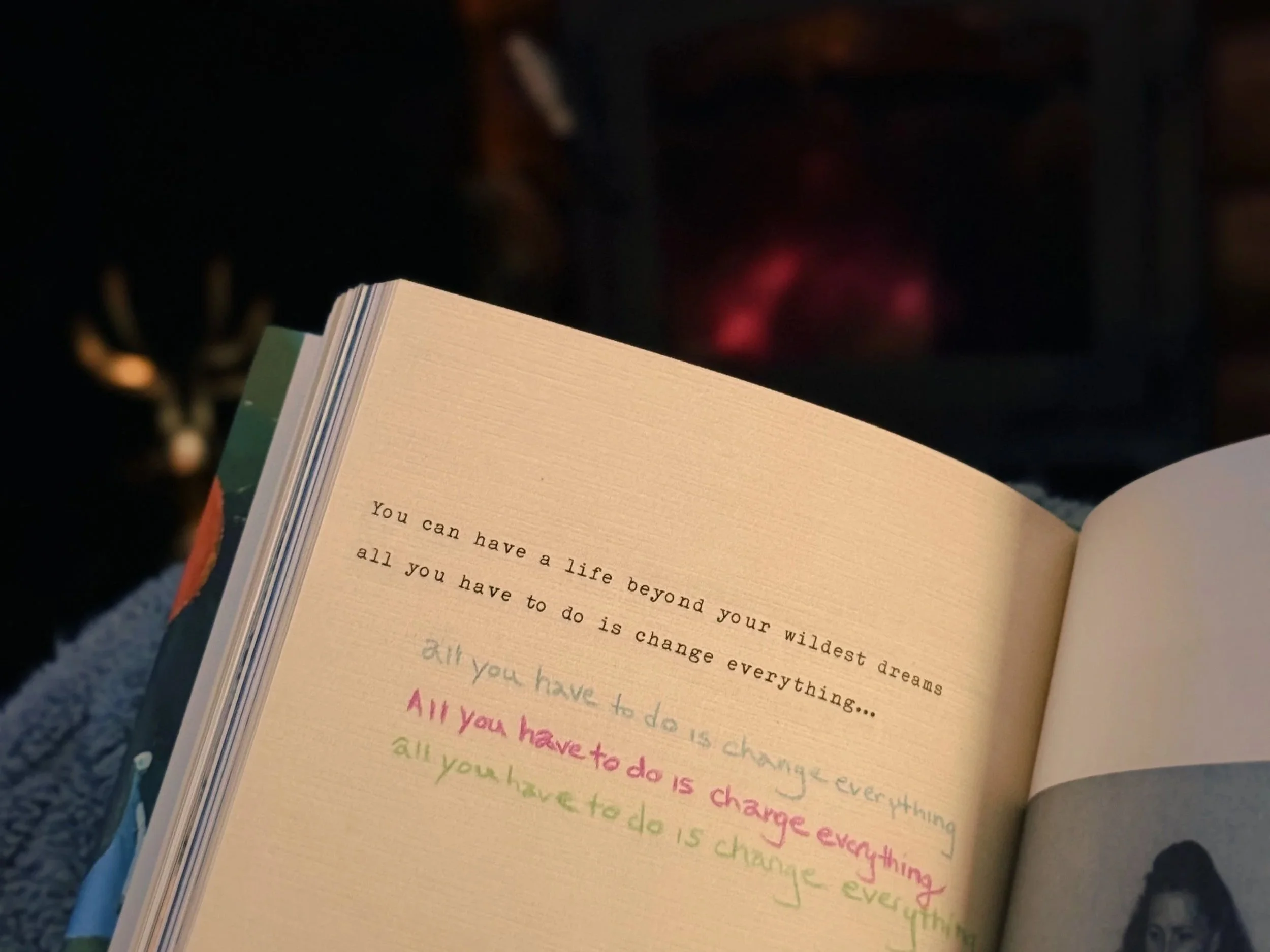
That afternoon, I sat down to read “Violet Bent Backwards Over the Grass” by Lana Del Rey. A book of her poetry and photography. She’s one of my favorite songwriters, next to Dylan, and I had to have it in my small library. I liked it, but not as much as her lyrics. I read it in one sitting as the sun slowly sank behind the pines. The fire crackling, happily fed. I hadn’t pissed it off too much today yet.
My favorite line from the book was:
Maybe an artist has to function a little bit above themselves
if they really want to transmit some heaven
I let the heat from the fireplace warm my bones after the three-hour ice-cursion.
It felt good to just sit—to simply be—listening to nothing but the snaps and pops of the logs.
I don’t need much, but I do need the elements, I realized.
I could have packed more into the weekend, but this felt perfect. Sitting, thinking, writing—just being.
There’s something about nature that allows for more of that.
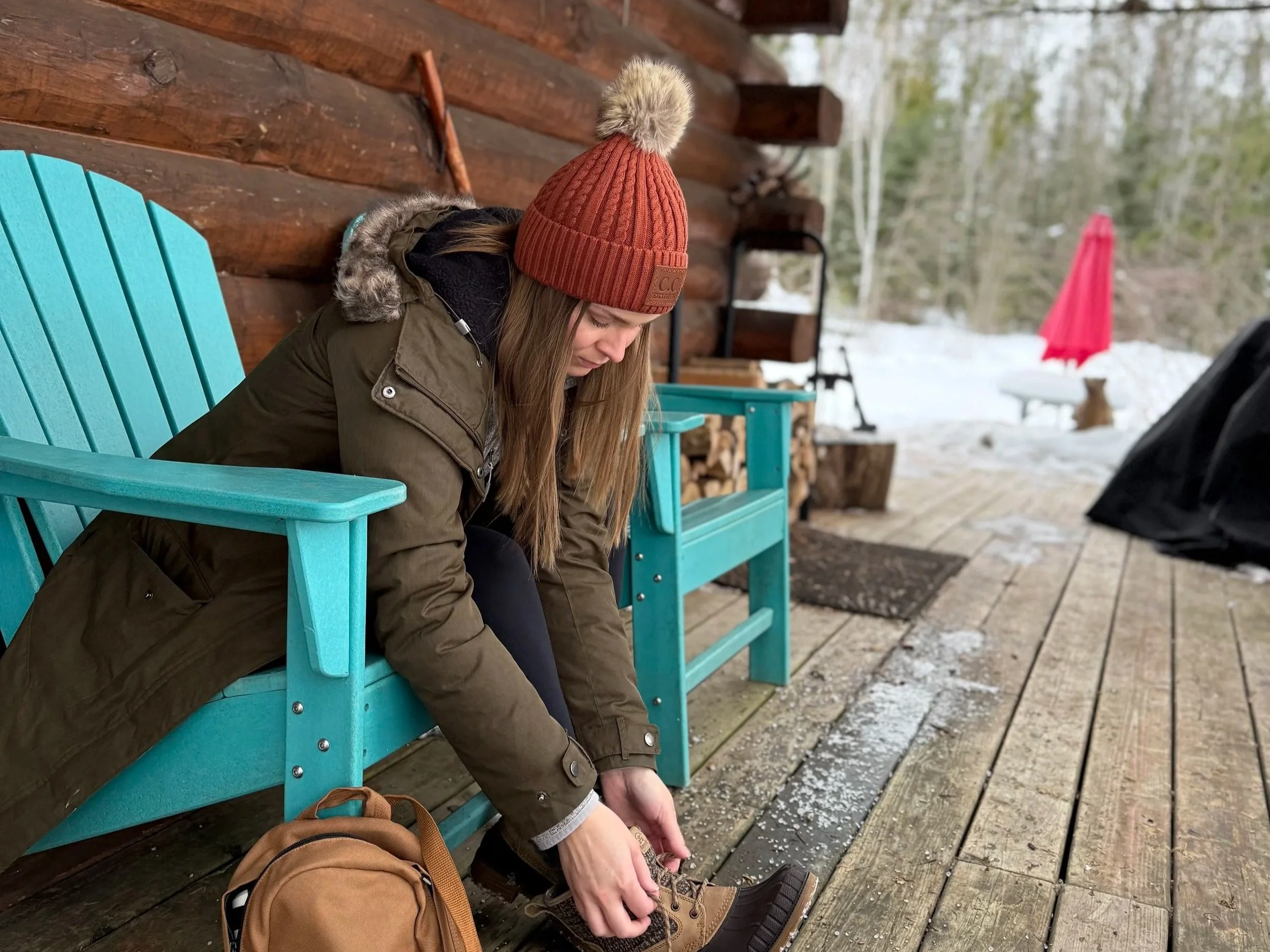
When I hit the road the next day—having survived my final night with slightly less anxiety and a little more favor from the fire—I felt a twinge of sadness. Brimming with all of the beautiful and stretching experiences I’d just had, it felt as if they were suddenly dumped and scattered across the long stretches of flat prairie that now lay before me, welcoming me home.
I thought about everything I’d pushed myself to do over the weekend—the long drive, the awkward meals, the anxious nights, the stubborn stove, the uncertainty of Lake Superior.
Stimulated and inspired by it all, I left Wisconsin—my little cabin in the woods—feeling stronger than when I arrived. Like I always do when I confront something unfamiliar: learning a new skill, navigating the unknown, solving problems in real time, sitting with my own thoughts.
Alone, but not lonely.
I’m not fearless. I’m not careless or reckless, either.
I’m afraid of injury, of accidents, of being alone if something went wrong—and of what that would mean for the people I love.
I am, however, compelled to face my fears. And to feel alive beneath my skin. To experience the world outside the walls of my cozy apartment. To try new things. And to grow in confidence of my capabilities. And when conditions don’t align perfectly for me to experience those things with other people, I simply must step out and do them on my own.
A few days later, it occurred to me that maybe the reason writing feels so important—so crucial—to me is because it gives those scattered pieces somewhere to go. It offers a container. A place to hold the story, the memory.
And maybe most importantly, a way to share it.