Between Grief and Graceland

I had a terrible time in Memphis.
Not because I didn’t enjoy the mouthwatering barbecue, rich southern culture, deep musical history, or the countless sights and activities. Memphis is a city worth visiting—by all means, go.
I had been looking forward to this trip for months. After a year of navigating life post-breakup and struggling through the early stages of launching my own business, this felt like the adventure I needed—a fresh start to welcome a new decade of life. My 30s.
During the summer of 2023, as I contemplated how to celebrate my upcoming March birthday, it dawned on me—I should visit Graceland, the iconic home of Elvis Presley. I was in my peak Elvis obsession, and Memphis seemed perfect—steeped in music history, home to Sun Studio and the legends who recorded there. The warm spring weather would be an added bonus, especially compared to North Dakota’s lingering winter.
But who would go with me?
I didn’t know anyone else who shared my level of enthusiasm for Elvis, but then I remembered—my dad did. So I invited both of my parents. They were excited. We had something to look forward to.
On the morning of March 7th, 2024—three weeks before our trip—I received a phone call from my mother at 8 a.m. Before I even answered, I knew. My body washed over with a feeling all-too familiar. A knot of dread and anxiety twisted in my gut as I prepared for whatever bad news was on the other end of the line.
“It’s Anfernee…” My mother managed to get out. “Your brother was in a bad fight and he lost his life last night.” He was only 24 years old.
You don’t forget those phone calls. They have a way of etching themselves deep into your memory, drawing the line between before and after. The words hit like a stone dropped into still water, sending out shockwaves that expanded into slow circles of pain.
My family took in Anfernee as a foster child when he was 5 years old and later adopted him and his brother. I still remember his first night in our home—how my mother gave him a warm bath and dressed him in cozy red Spider-Man pajamas, which he was very excited about. I watched as they sat together on the couch in the lamp-lit living room, her voice soft as she read him books before bedtime. I wondered if he’d experienced that before.
Early Days With Anfernee
In those first few months after Anfernee came to live with us, I would walk with him and my other brothers to the library, just a few blocks from home. I’d take his small hand in mine and gently—but firmly—remind him not to curse when he loudly commented on the houses we passed. We were not allowed to swear in our family, and as a 10 year old at the time, I was shocked (and amused) at some of the words that came out of this little boy’s mouth. He brought a wild, untamed energy into our home—an adjustment for all of us. But I can’t begin to imagine the adjustment for him, being uprooted from everything familiar, separated from his biological siblings, and placed in an entirely new town with a family of strangers.
Grief, uncertainty, and the decision to still go
The days and weeks that followed that 8 a.m. phone call were a blur of tears and funeral arrangements. I spent most of that time at home with my family, encased in sadness and anxiety. After the funeral, my parents and I hesitantly brought up the trip. Did we still want to go? Would it feel wrong to leave?
In the end, we agreed—it might be good to get away, even just for a little while. A change of scenery wouldn’t erase the grief, but maybe it would give us space to breathe. We knew it wouldn’t be much of a celebration, not with the fresh wave of loss still settling over us. But we would be together. And that, at least, would matter.
Leaving Home
The night before our early morning flight, Fargo was under severe blizzard warnings. I hadn’t slept—not that night, not the one before. Only three weeks had passed since Anfernee’s death, and the thought of stepping outside, of leaving the comfort of my bed was debilitating. My body didn’t want to go. I wondered if we’d made the right choice. It just all felt like too much too soon.
Secretly, I hoped our flight would be canceled. I searched for any reason to stay put. I Googled, “Are chills a symptom of grief?” The internet listed many symptoms, but chills weren’t one of them. And yet, my bones weighed heavy with a cold dampness that soaked right to the core.
At 4:30 a.m., my alarm went off. I checked the airline app. No cancellations. No excuses. My parents were already up, getting ready.
By the time we raced across the airport parking lot in the early-morning darkness, the unforgiving midwest wind had cut straight through me. All the heat had been snatched from my body, like a candle snuffed out too soon. And I knew it would take more than a warm destination to bring it back.

The Hernando de Soto Bridge, also known as the “M Bridge” for its distinctive shape.
Arrival in Memphis
When we landed in Memphis, I was shocked by how cold 60 degrees felt. In North Dakota, anything above 50 is practically shorts weather, but warmth still evaded me. We arrived at The Guest House at Graceland—a glamorous hotel with live music, multiple bars, and the kind of charm that makes you forget you’re technically not on Elvis’ actual property. In the hallways, brass wall sconces shaped into the initials “EP” lined the walls.
Before check-in, we had lunch at EP’s Bar & Grill, then wandered the hotel. Eventually, we found a quiet seating area, and my dad dozed off in his chair. I snapped a picture, captioning it “Sleeping in Memphis,” feeling only mildly clever. Finally, we got to our room. All I wanted was to crawl into bed, wrap myself in blankets, and sleep. But it was mid-afternoon, and my mother, ever the meticulous planner, had an itinerary ready. She rattled off options, determined to make my birthday trip feel as special as possible.
We decided on a wine bar, followed by a visit to the Bass Pro Shop, housed inside a massive glass pyramid—because, as I had learned, Memphis leans into its namesake, the ancient Egyptian capital on the Nile.
It was drizzling when we stepped outside.
Our Uber driver warned us about Memphis’ high crime rates. We listened, but our minds were elsewhere.
At the top of the Bass Pro Shop, we sat in the restaurant, surrounded by glass windows overlooking the city. Below us, the “M Bridge” stretched across the Mississippi River, connecting Tennessee to Arkansas. Rain trickled down the windows, distorting the bright lights of the bridge. The observation deck was closed due to weather, so we watched quietly from inside, separated by glass, suspended between here and there.
I thought about Chuck Berry’s song, later covered by Elvis:
“Her home is on the south side, high upon a ridge, just a half a mile from the Mississippi bridge.”
He wasn’t singing about this bridge, but somehow, it felt the same.

Graceland / 30th birthday
The next day—my 30th birthday—was dedicated to touring Graceland, a plan I had made intentionally. If I was going to visit Elvis’s home, it had to be on my actual birthday. A friend once joked that for me, visiting Graceland was like a pilgrimage to Mecca. My Elvis obsession began the way all my musical fixations do: I watched the Elvis movie, spiraled into deep research on his life and music, and ultimately decided he was my all-time favorite artist. I admired his journey—from a humble, two-room house in Tupelo, Mississippi, to living like a king in his Memphis mansion. He was a dreamer. Massively talented. Culturally groundbreaking. Deeply spiritual. Eccentric. Wild.
On the tour bus from our hotel to Graceland, the guide sang “Happy Birthday” to me— she had asked if there were any special celebrations that day, and before I knew it, the entire bus was in on it. I smiled politely through the song, only mildly embarrassed.
My parents and I had opted for the Ultimate VIP experience, wanting to make the most of the day. We spent hours exploring the mansion, walking the grounds, and marveling at the over-the-top decor—my favorite being the Jungle Room, featuring green shag carpet on both the floor and ceiling, heavy Polynesian-inspired wood furniture, and an indoor waterfall. The outdoor memorial area, where Elvis is buried alongside his family, felt especially moving.
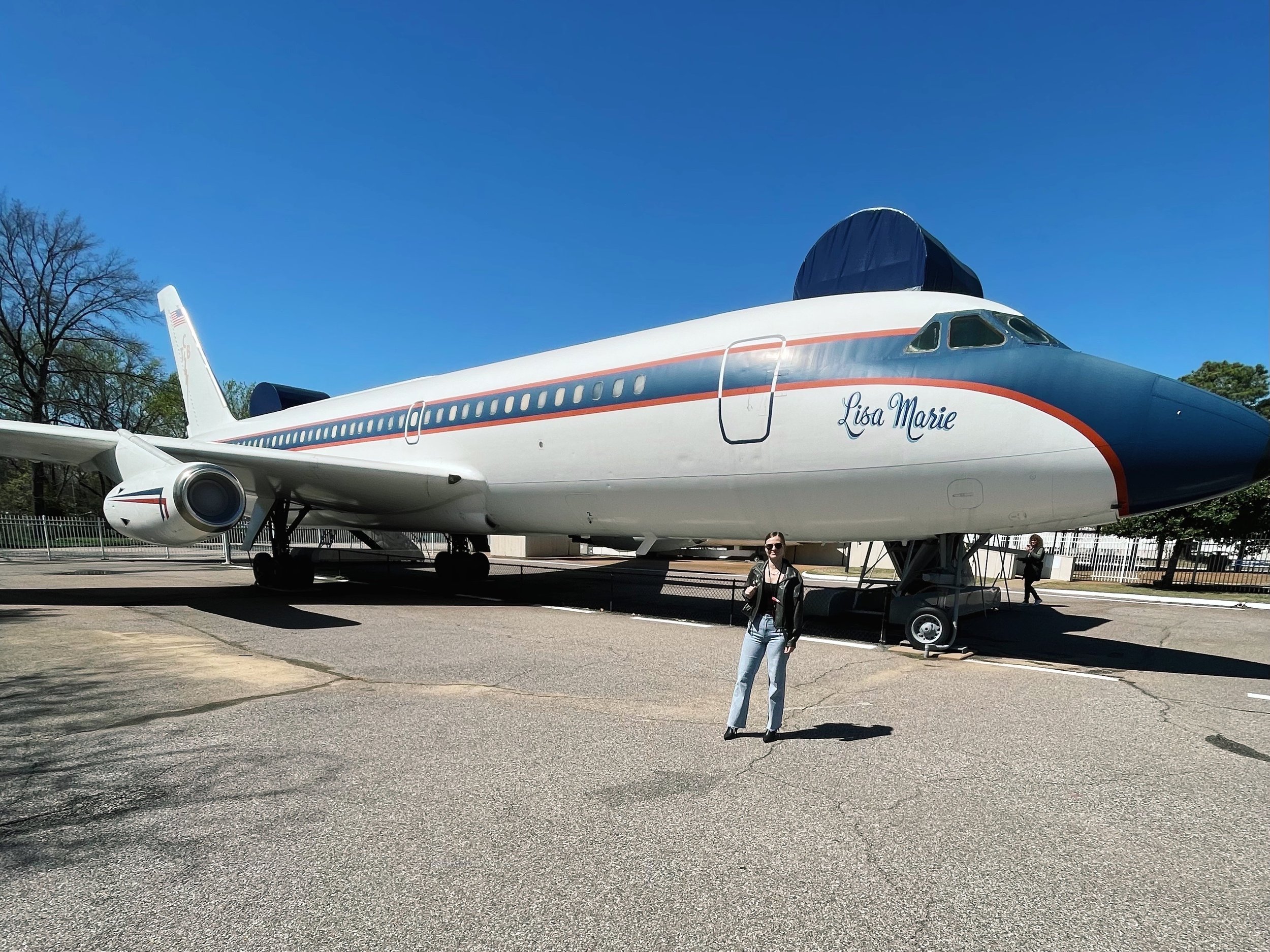
We browsed through countless artifacts, admired the costumes from his legendary Las Vegas shows, and took in his impressive collection of beloved Cadillacs. Our guide, brimming with knowledge, shared story after story, each one adding another layer to the myth and man that was Elvis Presley. One of the attractions I had been looking forward to the most was touring his private jet, the famous “Lisa Marie,” affectionately named after his daughter.
I should have felt more excited.
But beneath it all, there was a gnawing in the pit of my stomach—an inescapable reminder of the loss that followed us everywhere, including here. And no matter how brightly the sun shone in the clear blue Memphis sky, I couldn’t shake the chill that clung to me, deep and unrelenting.
Beale Street & Memphis history
Our last full day was packed with a city tour and a visit to the legendary Beale Street. The tour took us to Lansky’s, the upscale clothing store where Elvis shopped, and Sun Studio, the iconic recording studio where he—and countless other legends—got their start. We stopped at the luxurious Peabody Hotel just in time for the beloved duck march, then drove past the Lorraine Motel, where Martin Luther King Jr. was assassinated—a sobering moment that contrasted the city’s vibrant energy. As we took in the skyline, our guide pointed out historic landmarks, weaving stories of Memphis’ past and present. Finally, we arrived at Beale Street—alive with the raw, soulful sounds of blues music and an electric atmosphere. We walked all along the bustling street down and back, popping in and out of souvenir shops along the way.
That night, after returning to the hotel, we found a local band playing in the lobby, serenading guests with cover after cover of slow southern rock. I was exhausted, but my dad wanted to stay, to enjoy the music on our last night. My mother headed up to bed, and I ordered an Old Fashioned at the bar. We sat as close to the music as we could, talking in quiet intervals between songs. Our conversation drifted around Anfernee, our family, and life. More than anything, I let my dad talk. I felt he needed to.
Weariness settled around his eyes, where laugh lines had long been etched. I had always admired his natural joyfulness, the unwavering positivity that had given our family strength in uncertain times. But beneath the warm glow of the hotel’s glamorous chandeliers, his usually bright blue eyes dimmed with a quiet sadness.
Anfernee was our family’s second great loss; the first had been my other brother, Jesse, seven years earlier. Both were horrific, both untimely. Both had left our family shattered, padding around in the wreckage, trying to pick up the pieces of our lives. Between sips of bourbon and the band’s rendition of Southern Nights, we rehashed these tragedies as if we could somehow solve the pain—the deep, unanswerable ache of why?
I continued to let this question haunt me as I finally made my way to bed for the night.
The Flight Home
On our flight home, the plane was nearly empty, and I was fortunate enough to have the whole row to myself. It gave me the time and space to let my mind wander—processing the trip, the funeral, and the traumas that had plagued our family.Then, out of nowhere, a dark, self-indulgent thought crept in: Was I put on this earth just to suffer? To take the punches life threw at me and try my best to survive them, one after another?
I looked out my window searching for some sign, or answer, when I caught a glimpse of the setting sun through layers of clouds. It looked exceptionally vibrant, but only slivers of it reached my eyes. I craned my neck, desperate for a clearer view, but the plane kept moving, and the clouds never parted enough to give me the whole picture. Soon, we were enveloped by the night, and my heart sank with the sun. It felt like the universe itself was rubbing salt into an undressed wound. I just wanted some light. Some warmth. Some hope.
Suddenly, I sensed movement in the aisle next to me and turned to see my mother shuffling into the empty seat in my row. “What’s up?” I asked, my voice a little sharper than I intended. “Nothing,” she replied, settling in beside me. “I just thought you might not want to be alone.”
I definitely wanted to be alone. Bitter and miserable, I was reeling from a year of highs and mostly lows, searching for a place to land. After leaving the security of my full-time job to pursue self-employment, I had been trying to get my business off the ground, while dealing with the aftermath of an agonizing breakup, and treading water in an endless ocean of uncertainty. I had dismantled everything—broken it apart with the full hope of creating something meaningful, something lasting. To build a life I could be proud of, knowing I had taken the more difficult road to get there. But now, I felt more unstable than I had at 20, in a world colored with a new shade of grief.
What was it all even for?
As the plane hummed steadily through the evening, my mother and I sat together in silence, side by side. I wasn’t alone. I had family, friends, and treasured memories of those I love, and have lost, to hold onto. In time, I knew I would find my way through the smog of deep sadness and uncertainty, just as I had before. Eventually, I would regain the warmth that had been stolen from my body. If I dug deep enough, I could still find the spark that was always there—the tiny glimmer that kept me going, no matter what. The hopeful glow of survival. And after a while, that spark would ignite into something much brighter.