From Canada to the Camino: Patience, Preparation, and the Path Ahead
I was slowly waking up on a soft, sunny Saturday morning when my right calf suddenly seized into a screaming Charlie horse that jolted me fully out of sleep.
“Ahhh!” I cried out, trying desperately to soothe the muscle, but it was locked tight. There was nothing to do but wait it out.
Eventually, the cramp eased enough that I could get out of bed, grab some water, and stretch it out.
I’d walked 12 miles that week, and apparently my body wanted to make sure I knew it.
Back in March, I started walking about 4 miles at a time, scattered throughout the week whenever I could, depending on weather and time. Now, in the middle of June, I was heading to Morden, Manitoba, Canada for a longer hike with my mom that we had planned.
Up to that point, we’d been training individually for what would become the longest walk of our lives: 75 miles from the Portuguese border to Santiago de Compostela, Spain.
What Would Compel Us to Do Something Like This?
Three summers ago, I read The Alchemist by Paulo Coelho, a novel about a shepherd boy following a recurring dream across the desert, guided by omens and something he calls his “Personal Legend.” I was in a season of uncertainty, trying to make sense of what direction my life was supposed to take.
It struck something in me.
After finishing it, I looked up the author the way I always do when something lingers. I’m often more curious about the person behind the work than the work itself—what inspired them, what they were reaching for.
That’s how I learned Paulo Coelho had walked the Camino de Santiago before writing it.
I clicked through to the Wikipedia page and started reading.
The Camino de Santiago is a network of long-distance pilgrimage routes that lead to the city of Santiago de Compostela in northwestern Spain.
At the end of the route is the Cathedral of Santiago de Compostela, where tradition holds that the remains of the apostle Saint James are buried. For more than a thousand years, people have walked these routes for religious, spiritual, cultural, and personal reasons.
About a month after reading the book, I met someone who had actually walked the Camino.
I remember joking, “So, did you find yourself?”
“Yes,” he answered in a serious tone. “It was actually quite spiritual.”
“Oh,” I said, nodding back soberly. “That’s awesome.”
Secretly, I was thinking, How could a walk be spiritual? What happens on this trail?
Nevertheless, my curiosity was piqued, and I made a silent wish to experience this pilgrimage for myself one day and see what it was all about.
Three Years Later
Fast forward three years, and my life looked completely different. The uncertainty that drew me to The Alchemist had slowly given way to something steadier. I'd done all of the soul-searching a person could possibly do in a lifetime. I'd traveled, picked writing back up again, found work I loved, built beautiful relationships. Almost every piece that had fallen apart, I'd managed to put back together into something even better.
One Sunday afternoon in early spring, I was on the phone with my mom, laying T-shirts and socks across my living room rug to air dry what my apartment's dryer couldn't seem to.
She casually—almost hesitantly—mentioned that she was planning to walk the Camino de Santiago.
"What? How do you even know what that is? Have I talked about it with you?"
"No," she said. "I learned about it after reading The Alchemist, the book you recommended."
"Oh... well, I've been wanting to do that! Did you know that?"
"No," she laughed. "I had no idea. I have a friend who leads group tours, and I decided I wanted to do it. I was just going to go by myself."
"Moooom, you can't go by yourself."
She'd only been overseas once before, years ago, and that was with our whole family. At the same time, I couldn't help but admire her willingness to step out and do something like this on her own.
"How much does it even cost? When are the tours available?"
As she explained more about the trip, I studied the muted blue, cream, and brown flecks in my rug, looking over my carefully arranged T-shirts and socks. I could feel the slow rise of excitement bubbling up from somewhere deep inside me.
"I think I'm going to go with you," I said finally.
"Oh, are you sure? You don't have to. I'll be just fine on my own."
"No, I want to."
"It's been on my bucket list of things to do. I just didn’t think I would find someone who would want to go, too."
After some additional conversations, it was decided that we would go in September.
Walking the Same Ground
That brought us to Canada in the middle of June.
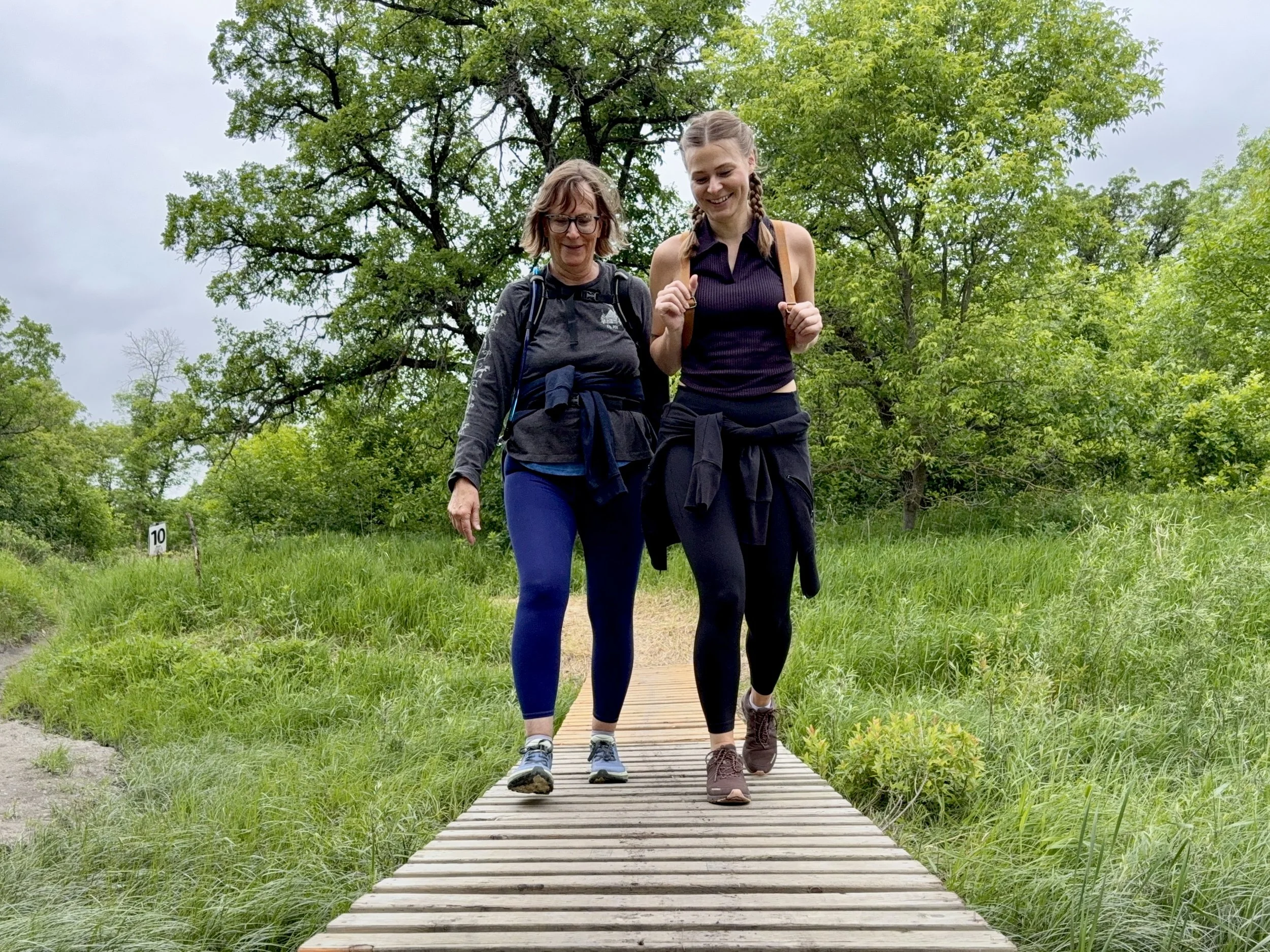
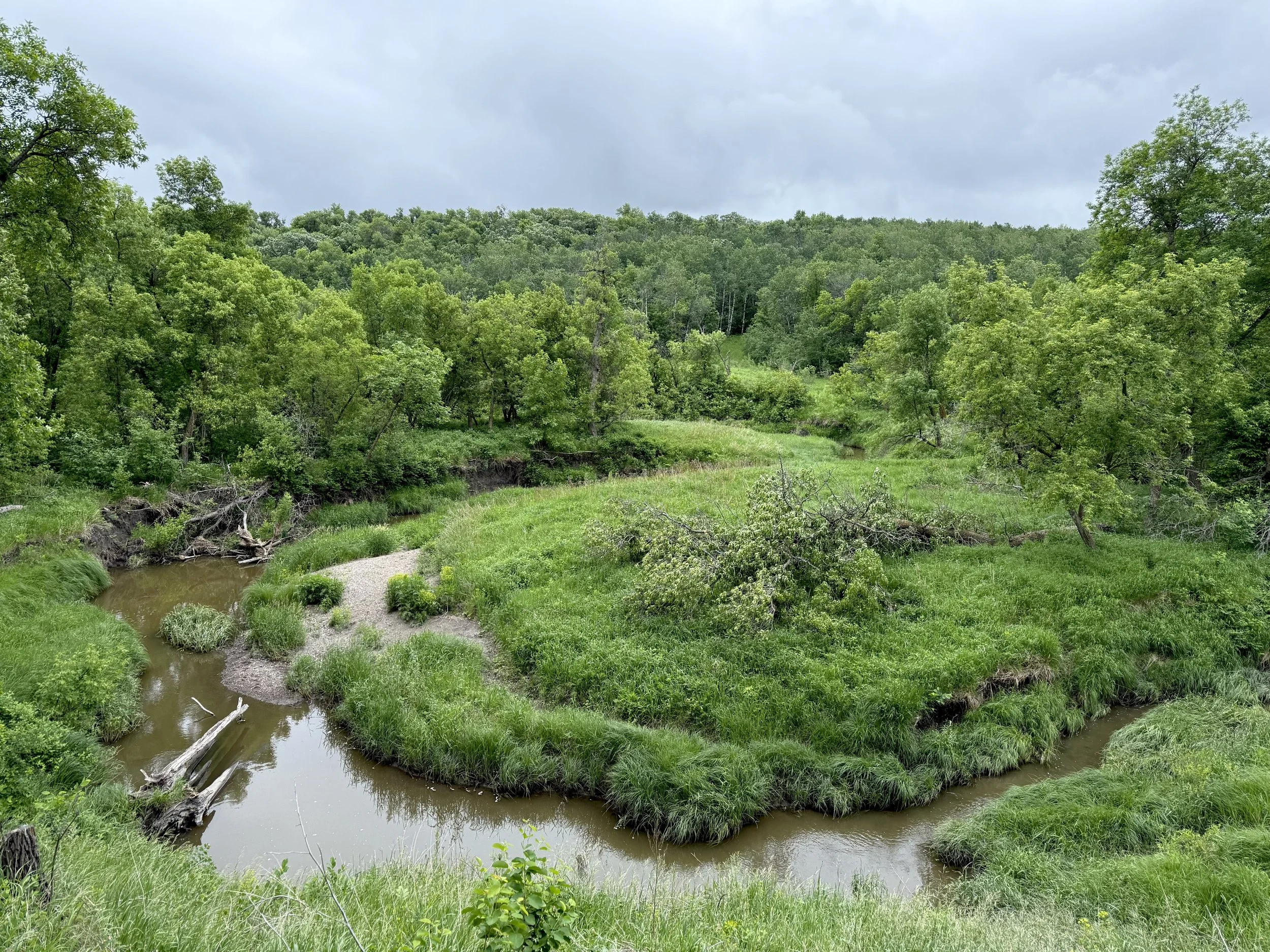
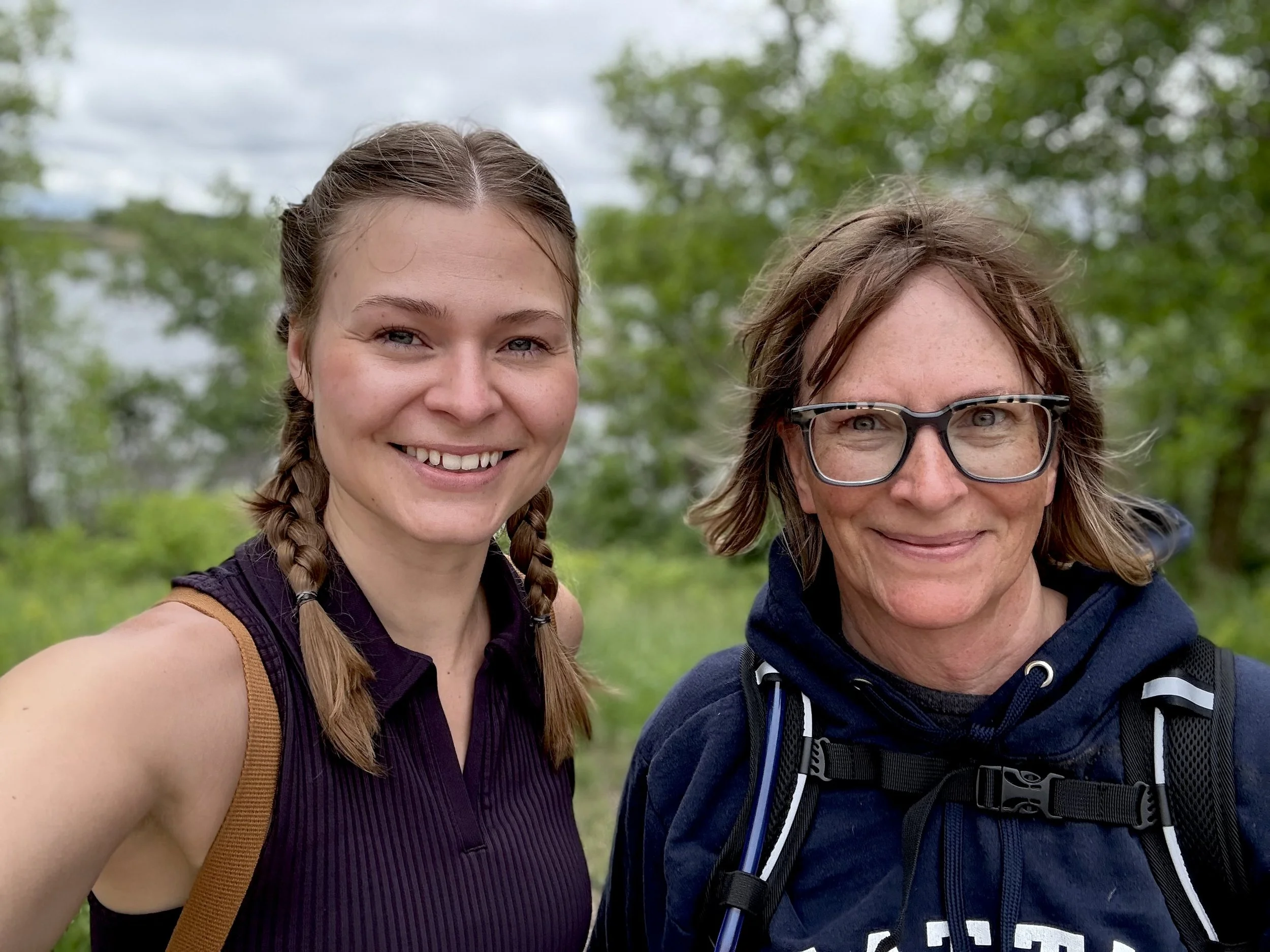
We were at the point in our training where we were supposed to start adding more miles to at least some of our regular walks. We settled on a 6.2-mile hike around Lake Minnewasta in Manitoba—a reasonable drive from my parents’ place. The forecast wasn’t looking too promising, showing mostly cloudy skies with chances of rain off and on throughout the day.
“We’ll have to walk rain or shine when we’re in Spain,” my mom said. “We might as well get used to it.”
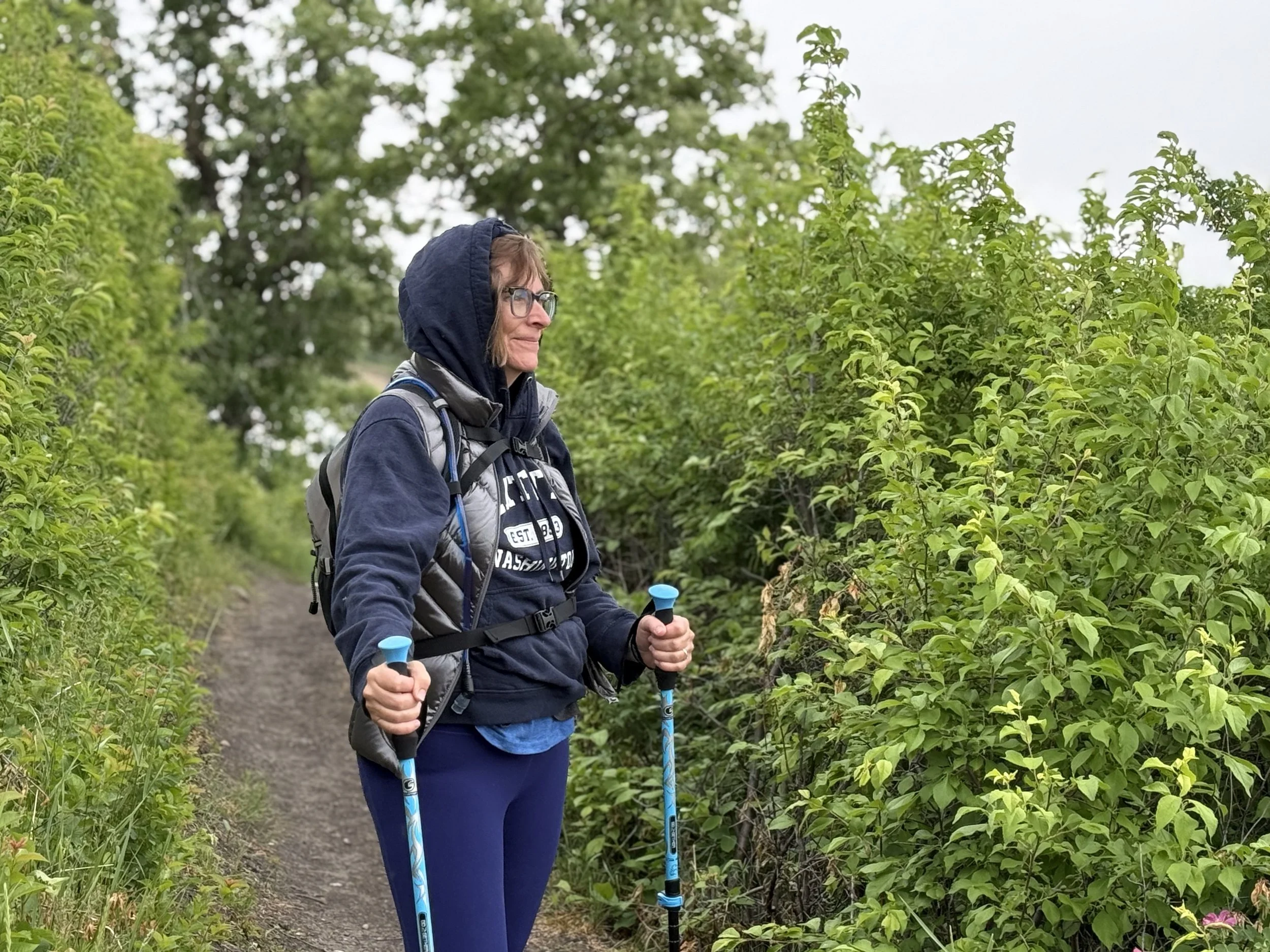
I agreed, and we stuck to our plan, tucking sweatshirts and light raincoats into our daypacks.
I had walked part of this same trail with my mom before, three years earlier, during that time of uncertainty—a season that I affectionately refer to as my 2023 Renaissance.
I remember a conversation we had back then. She knew how much I was struggling and said to me, “If this were a movie, this would be the part where things start to turn around for you.”
Looking back now, my life didn’t come together all at once the way I wanted it to. It happened slowly, one step at a time. Change was quiet and incremental. Good things started to build with patience, effort, and paying attention to the direction I felt I needed to go.
Going Nowhere Fast
A little ways into the hike, my mom stopped to check our progress on her watch. Light rain filtered through the thick canopy of trees above us.
“Well, we’ve walked 1.6 miles.”
“That’s it?” I replied, surprised. “It feels like it’s been longer.”
When I walk alone, I never check the time or the mileage. I just listen to music—whatever I’m in the mood for that day: pop, classic rock, indie, alternative, classical. I know I have about a two-hour commitment ahead of me for my regular four-mile walk, so I just embrace it.
Just me, my thoughts, and the path ahead.
One thing I've realized about walking is that it's not the activity itself that's difficult—it's the time it takes. You're going nowhere fast. The challenge isn't speed. It's enduring the boredom, monotony, unfavorable weather, and the days you simply don't feel like it.
But most of the time, I love it. I've enjoyed having a goal to work toward—knowing that if I don't train consistently, I'll only make the Camino harder on myself. Somewhere along the way, these walks have become more than preparation. They've become a reprieve at the end of a workday and a priority on the weekends. A place to sort through everything on my mind.
You can’t really hide from yourself on the trail. Not that I could, even if I wanted to.
We completed the loop in 2 hours and 40 minutes, including a few stops for snacks and one brief stall for heavier rain where the trail opened onto the golf course. The final stretch featured a handful of steep inclines that made us feel like we'd truly earned the cheeseburgers we ordered afterward at the Rendezvous Eatery and Taphouse—mine paired with an IPA that went down far too easily.
“Are you sore?” my mom asked on the drive back.
“No, not really. You?”
“No,” she said. “I actually feel pretty good.”
So did I.
I had complete confidence in our ability to conquer the Camino.
Open to Whatever Comes
The next morning, over coffee before I headed home, we talked about the people we knew—or the stories we'd heard—of those who had walked it before. So many seemed to have a reason for going. Some were moving through grief. Some were working through a crisis. Some wanted to get lost. Others hoped to find themselves.
“I don't really feel like I have a reason,” I admitted.
“Honestly,” my mom said, “I don't really either.”
And that felt strange to say out loud.
Three years earlier, I probably would have had a very different answer. Back then, I was searching for certainty, meaning, direction—anything that could help me make sense of where I was in life. But now, I don't feel like I'm looking for anything in particular.
It's a different season. A good one.
The more I thought about it, the more I wondered if the spirituality of the Camino has less to do with reaching the end of the journey and more to do with the act of walking itself.
On the Camino, there's nowhere to go but forward. You're removed from your normal routines. There are no emails to answer, no laundry to fold, no endless list of errands waiting for your attention. The distractions that usually fill our lives become remarkably quiet.
What's left is time.
Time to think. Time to notice. Time to connect with the people beside you and the strangers you meet along the way, each carrying their own stories, griefs, hopes, and questions.
Time to sit with parts of yourself that everyday life rarely gives you space to encounter.
Maybe that's why so many people come away changed.
As for us, maybe it's enough that we're not searching for anything specific. Maybe the best thing we can do is remain open—to the experience itself, to whatever conversations arise, to whatever the trail has to teach us.
And perhaps that's reason enough to walk it in the first place.